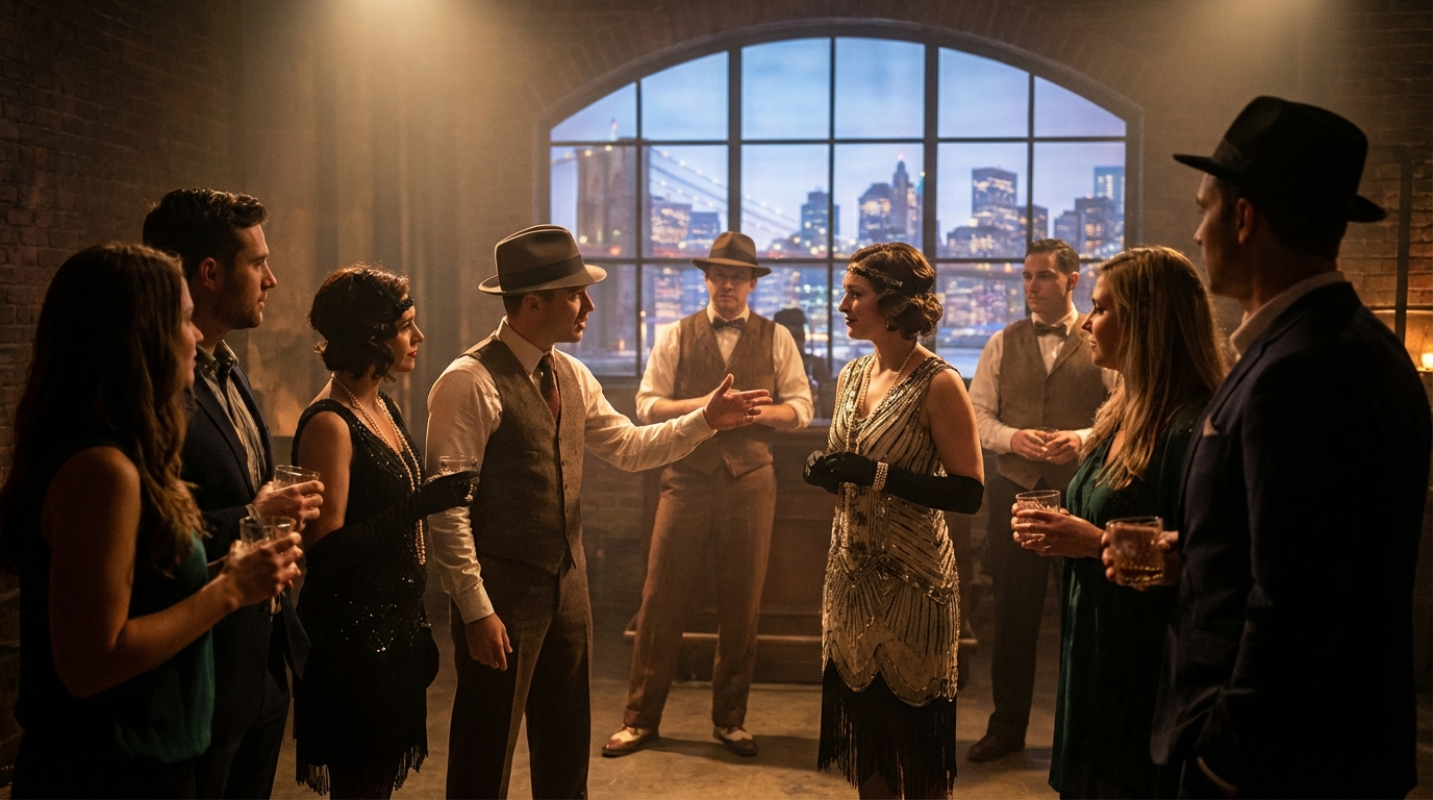
 (Image source: Gemini)
 Forget the plush velvet seat, the dimmed house lights, and the distant stage. That’s traditional theater, and frankly, it’s not what people are craving anymore. Today’s audiences want to be active participants, detectives, diners, or even jurors in the unfolding drama. They want to step inside the story.
This is the power of immersive theater. It’s a dynamic, boundary-pushing art form where the narrative wraps around you, demanding your presence and engagement. You are no longer watching the play; you are the catalyst for its next scene.
The shift toward this participatory experience has been dramatic, especially in the wake of the pandemic. After years of isolation and screen time, there’s a desperate hunger for shared, active experiences that can’t be replicated online. This art form delivers exactly that, transforming forgotten warehouses, historic mansions, and even entire city blocks into living, breathing worlds.
But where do you find the best of the best? Where are the true hubs where creators are risking it all on high-tech spectacles and intimate, life-altering encounters? Although the immersive entertainment market is growing globally, a few select cities have become needed pilgrimages for anyone serious about stepping inside the story.
New York City
New York City has always been a theatrical powerhouse, but its immersive scene takes that legendary energy and multiplies it tenfold. It’s here you find the extremes: the largest, most expensive free-roam epics alongside hyper-intimate dramas staged for just a handful of people.
NYC’s dominance is defined by its ability to scale. The city is home to productions that are less theater and more architectural marvel, designed to run for years. Think of the massive, long-running productions that redefine the relationship between movement, mystery, and audience agency. These shows often involve complex choreography and a vast, multistory environment, turning the simple act of navigating a building into a key part of the narrative.
But the scene isn't just about massive budgets. Downtown Manhattan and the bustling corners of Brooklyn are breeding grounds for smaller, riskier projects. These companies thrive on the city’s experimental spirit, often adapting classic texts or creating entirely new worlds in unconventional spaces. Like, the troupe spit&vigor stages productions like Anonymous, where seven actors and a small audience sit together in a studio space, blurring the lines between performer and participant in a deeply personal way.
If you're looking for something interactive and lighthearted, NYC delivers that too. Drunk Shakespeare, a long-running hit, proves that sometimes the best immersion is simply being allowed to shout advice (or buy a round) for an actor attempting to perform while heavily intoxicated. It’s a comedy gold standard that understands the power of breaking the fourth wall and inviting the audience into the chaos.
New York’s scene is confident, diverse, and unapologetically ambitious. It sets the financial and artistic bar for what immersive theater can achieve, constantly pushing the boundaries of what a performance can cost, and how much freedom the audience can be given.
Top Recommendations NYC
- Masquerade: A massive free-roam musical spectacle that re-imagines Phantom of the Opera across a complex designed to evoke 19th-century Paris.
- Drunk Shakespeare: An interactive comedy where one cast member drinks five shots before attempting to perform a classic play. Audience participation matters.
- Accomplice: Blends interactive theater with a real-world scavenger hunt and walking tour through unique NYC neighborhoods.
London
If New York is about sheer scale and experimental diversity, London is about precision, historical depth, and hyper-integration of cutting-edge technology. The UK capital has long been the home of Punchdrunk, the company that codified the free-roam, mask-wearing style that became globally famous. Although Punchdrunk prepares for new anticipated works like Lander 23 in 2025, the city’s scene is accelerating thanks to major production companies focused on digital immersion.
London’s unique advantage is its abundance of historic architecture. Creators frequently integrate genuine historical settings or literary adaptations, grounding their hyper-real worlds in a palpable sense of the past.
The true innovation in London today lies in companies that seamlessly blend live actors with digital spectacle. Layered Reality, like, is a major player, responsible for the long-running success of Jeff Wayne's The War of the Worlds: The Immersive Experience and The Gunpowder Plot. These aren’t just walk-throughs; they use projection mapping, motion platforms, and multi-sensory effects to surround the audience in the fictional world.
Looking ahead, London is doubling down on digital technology. Layered Reality's upcoming Elvis Evolution (set for May 2025) promises to use generative AI alongside a life-sized digital Elvis, offering intimate, personalized moments within the experience. This focus on individual engagement, aided by technology, is a hallmark of the London approach.
And, of course, London perfected the art of immersive dining. Companies like The Lost Estate transport audiences to decadent, themed worlds, such as 1890s Paris in CHAT NOIR!, serving multi-course feasts alongside live cabaret and music. This fusion of gastronomy and theatrical storytelling has become a highly popular and lucrative sub-genre of immersive entertainment.
Top Recommendations London
- Jeff Wayne's The War of the Worlds - A multi-sensory experience combining live actors, virtual reality, and physical effects to tell the classic sci-fi story.
- ABBA Voyage - A concert experience featuring life-sized digital "ABBAtars" of the band, using cutting-edge lighting and projection mapping.
- The Lost Estate (e.g., CHAT NOIR!) - High-end immersive dining that stages a complete theatrical world around a three-course themed meal.
Beyond the Coasts
Although NYC and London dominate headlines, they also come with prohibitive costs. The high overhead often limits the ability of smaller companies to take major risks. This is why some of the most exciting, novel, and participatory work is emerging from secondary hubs, where creators can experiment with lower overhead, yielding higher returns on innovation.
Chicago stands out as a important hub for interactive and tech-driven experiences that prioritize audience agency. The scene here focuses less on massive, fictionalized free-roam worlds and more on direct, high-stakes participation.
Consider The Jury Experience in Chicago. This isn’t a passive show; it’s a gripping 60-minute simulation that puts the audience in the role of a juror. You are tasked with deciding the outcome of a courtroom drama. This is the definition of ludic involvement, where the audience’s decision determines the narrative’s conclusion. It’s high-stakes and deeply engaging, demanding immediate presence and ethical consideration from every participant.
Chicago is also embracing the next wave of display technology: augmented reality (AR). At venues like Verse Immersive, audiences wear AR glasses to bring 3D characters and stories to life, blending the physical environment with holographic imagery. This contrasts sharply with full virtual reality (VR), which isolates the user. AR improves the existing world, keeping the audience connected to each other while expanding the narrative space. This blending of physical presence and digital improvement is a defining trend for 2026.
Other cities, including Los Angeles, also contribute unique flavors, often leaning into the cinematic and horror genres. But it is the Chicago model - focused on agency, decision-making, and accessible, collaborative technology - that truly shows the geographic diversity of the immersive revolution. These cities prove that innovation doesn't require a West End budget; it requires a willingness to trust the audience.
Top Recommendations Chicago
- The Jury Experience - An interactive courtroom drama where the audience serves as the jury and must determine the verdict.
- Verse Immersive - Uses augmented reality (AR) glasses to overlay 3D holographic stories onto the physical space, creating shared, interactive worlds.
- Wonderverse - A massive 45,000-square-foot hybrid attraction featuring physical experiences mixed with VR and escape rooms based on major IPs like Jumanji.
What's Next for Audience Engagement?
Where is this revolution heading? The trend lines are clear: deeper personalization, more sophisticated technology, and a continued emphasis on giving the audience genuine power.
The market research confirms that audiences are willing to travel - 73% are ready to make a trip for an experience that captures their interest - and they are willing to pay for high quality. This demand fuels the technological evolution we see today.
We are moving past the novelty of simple VR headsets toward sophisticated hybrid experiences. The growth of AR and holographic theater matters here. It allows for the integration of digital characters and environments without sacrificing the shared, communal aspect of live performance. Think of the generative AI being used in productions like Elvis Evolution; this technology allows the narrative to respond dynamically to individual audience members, creating moments that feel written just for you.
Sources:
.png)
.png)