 (Image source: Gemini)
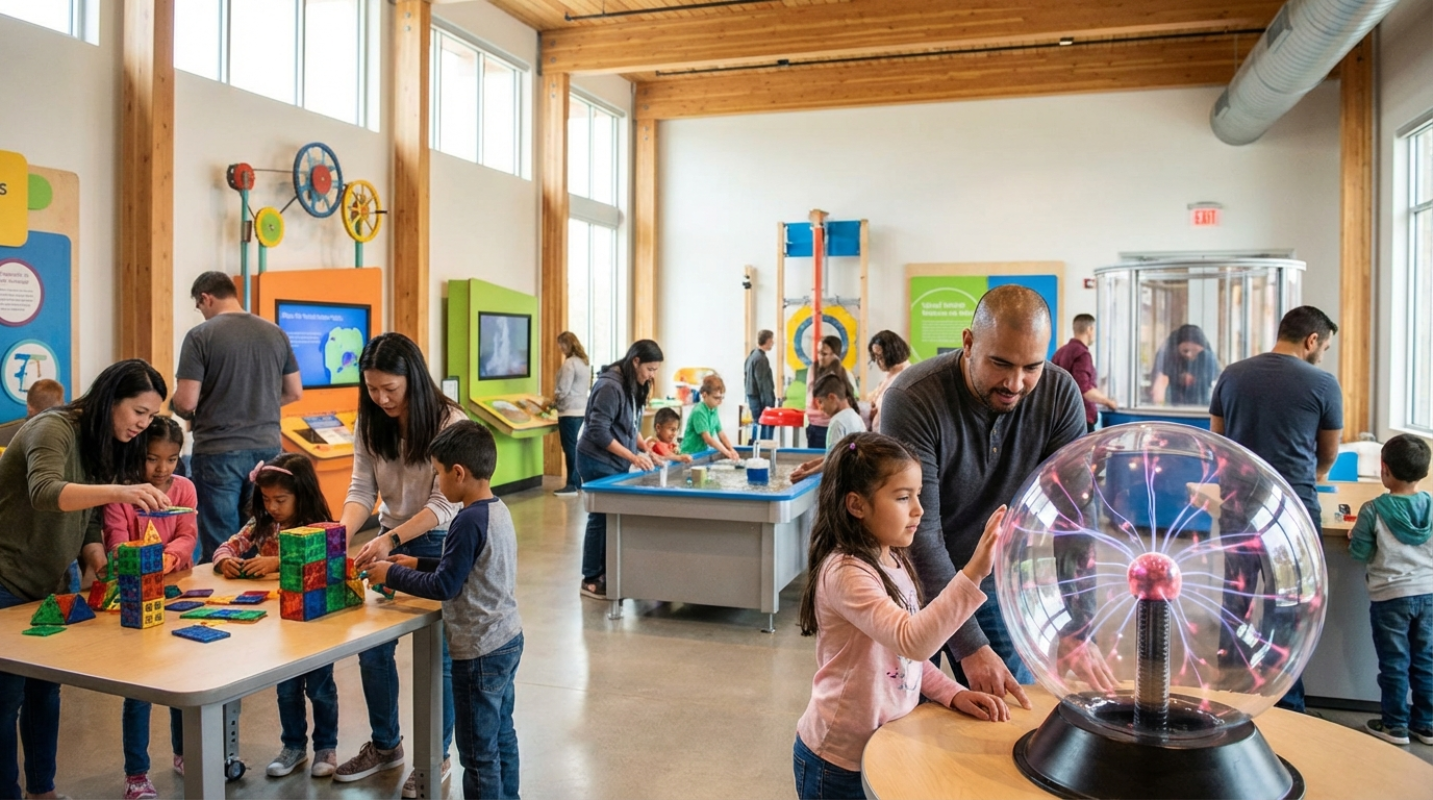
 Remember the old days of school field trips? You’d walk through a quiet hall, hands behind your back, staring at a dusty taxidermied bird or a rock behind thick glass. It was more like a library with a "do not touch" sign on every surface. Thankfully, those days are over.
The modern science center has transformed into what experts call a living laboratory. It’s a place where you don’t just look at a display about gravity, you feel it. You pull levers, launch rockets, and maybe even get a little messy. This shift from passive viewing to active participation is why these centers have become the ultimate destination for family travel.
Whether you’re traveling with a toddler who just wants to splash in a water table or a teenager who thinks they’re too cool for museums, these hubs offer something rare. They provide educational entertainment that actually sticks. We’re going to look at why these centers are winning the travel game right now, which ones you need to put on your bucket list, and how to plan a trip that doesn’t leave you exhausted.
The Educational Value and Why This Is Important
You might wonder if these places are just glorified indoor playgrounds. It’s a fair question. But the science behind "learning by doing" suggests otherwise.
When you physically interact with an exhibit, like feeling the torque on a spinning wheel or building a bridge out of foam blocks, you’re engaging in kinesthetic learning. A massive review of over 100 studies recently confirmed that this hands-on approach significantly improves how well we understand complex concepts compared to just reading about them in a book.² It turns out that when your body is involved, your brain is more likely to store that information for the long haul.
Think of it like learning to ride a bike. You could watch a thousand hours of video on the physics of balance, but you won't truly get it until you're in the seat. Science centers apply this logic to everything from climate change to quantum physics. Experts from the University of Chicago have found that physical interaction activates specific sensory-motor regions in the brain. This makes the "aha!" moment much more likely to happen.
Beyond just learning facts, these centers build a mindset of curiosity. They encourage kids (and adults) to ask "what happens if I do this?" That’s the foundation of important thinking and problem-solving. In a world that’s increasingly digital, having a physical space to test, fail, and try again is incredibly valuable for the future workforce.
Top Recommendations
If you’re looking for the best of the best, several centers have recently finished massive upgrades or opened brand-new wings that are setting the standard for the industry.
- COSI (Center of Science and Industry), Columbus, OH. This center recently reclaimed its spot as the top-rated science center in the country. It’s famous for its Dinosaur Gallery and a partnership with the American Museum of Natural History. The variety here is what wins people over, you can go from riding a high-wire unicycle to exploring the depths of the ocean in a single afternoon.³
- The National Air and Space Museum, Washington, D.C. If you haven't been since the major reopening in mid-2025, you’re missing out. They’ve debuted five new galleries, including the Boeing Milestones of Flight Hall. You can actually touch a piece of the moon and see the Apollo Lunar Module 2 up close. It’s the gold standard for space enthusiasts.
- Arizona Science Center, Phoenix, AZ. The big news here is the Dorrance DOME, which opened in late 2025. It uses an 8K LED system that’s about 100 times brighter than those old-school projectors. It’s easily the most immersive visual experience in North America right now.
- Exploratorium, San Francisco, CA. This isn't your typical museum. It’s located on a pier and feels more like a workshop. Almost all of their 600 exhibits are designed to be manipulated. It’s the birthplace of the "inquiry-based" philosophy, and it remains a must-visit for anyone who likes to take things apart to see how they work.
- Edelman Fossil Park, Mantua Township, NJ. This is a brand-new $75 million facility that opened in early 2025. It’s unique because it’s built on a 66-million-year-old fossil site. You don’t just look at bones, you can actually participate in live fossil digs. It’s the closest most of us will ever get to being in a Jurassic Park movie, minus the danger.
Beyond the Permanent Collection and Into the Future
The best science centers don’t stay the same for long. One of the reasons they’ve seen a massive surge in visitors, with some groups expecting over 5 million guests this season, is their focus on rotating exhibits.¹ If you visited a center three years ago, it likely looks completely different today.
We’re seeing a major trend toward "hopeful" climate exhibits. Instead of just showing a scary map of rising sea levels, new galleries like the ones at the Museum of Science in Boston focus on innovation and solutions. This helps prevent "eco-anxiety" in kids and focuses on what humans can actually do to fix things.
You’ll also find more immersive technology like VR labs and planetariums that feel more like movie sets. Like, the McDonnell Planetarium in St. Louis was recently named the best in the world for its programming. But even with all this tech, the Association of Science and Technology Centers notes that "authentic physical objects" still get the highest engagement. People still want to touch a real meteorite or see a 100-year-old engine in person.
Don't overlook the smaller, community-run science hubs either. Although they might not have the $20 million budgets of places like the Franklin Institute, they often offer niche experiences you won't find elsewhere. These can be great for avoiding the massive crowds of the "big name" museums.
Planning Your Visit for Maximum Impact
Let’s be real, a day at a science center can be a lot. If you go at 10:00 AM on a Tuesday, you’re probably going to be fighting for space with six different school field trips. If you want to actually enjoy the exhibits without a line, try visiting in the late afternoon or on a "member-only" morning if you can snag a pass.
One of the best-kept secrets in travel is the ASTC Travel Passport Program. If you buy a membership at your local science center, you often get free or discounted admission to hundreds of other centers worldwide. It can pay for itself in just one or two trips. It’s a huge win for families who travel frequently.
Accessibility has also become a major focus. Most top-tier centers now offer sensory-friendly hours with lower lights and quieter sounds. Port Discovery in Baltimore recently opened a new space-themed area specifically designed with low-sensory "sky" environments for kids who might get overwhelmed by the usual museum chaos.
If you’re traveling with a wide age range, look for centers that have dedicated zones. Most have "toddler towns" for the under-five crowd, leaving the more complex physics and chemistry labs for the teens. This keeps everyone from getting bored or frustrated.
Investing in Experiential Travel
Choosing to spend your travel budget on these centers is an investment in your family’s curiosity. We’re moving into an era where travel isn't just about seeing a landmark and taking a photo. It’s about having an experience that changes how you think about the world.
The future of science education tourism is looking bright. With new technologies like the LED domes in Phoenix and the live fossil digs in New Jersey, the line between "learning" and "adventure" is officially gone. These centers are proving that the most memorable part of a trip isn't what you saw, but what you did.
So, the next time you're planning a weekend getaway or a cross-country road trip, look for the nearest hub of discovery. Seek out the places that let you break things, build things, and ask questions. You might find that you learn just as much as the kids do.
Sources:


.png)
.png)