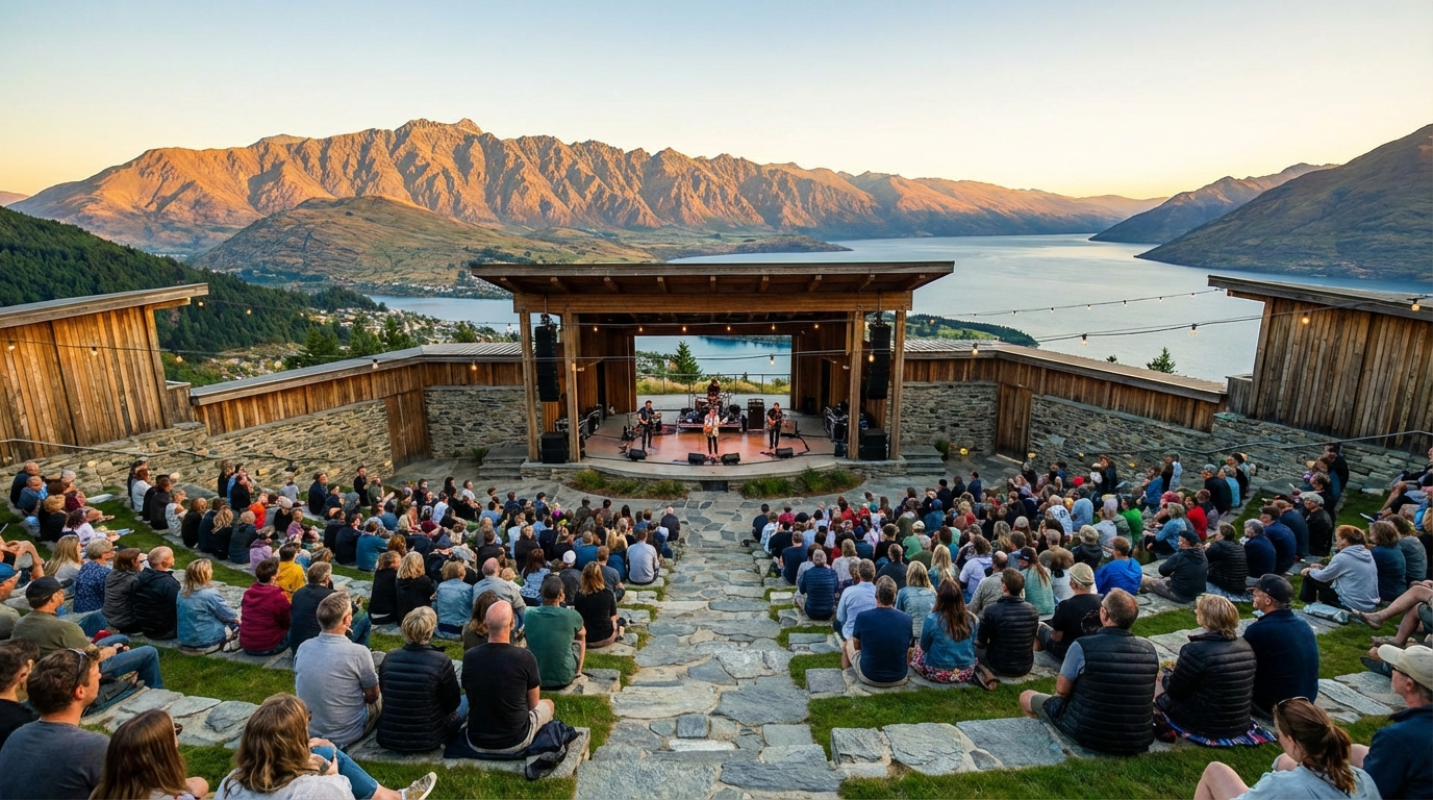
 (Image source: Gemini)
 Have you ever sat in a cramped, windowless arena and wondered why you paid a week's wages to stare at a concrete wall? You're not alone. There is a specific kind of magic that happens when a bassline kicks in just as the sun dips below a jagged mountain range or a river gorge. It changes the music from something you just hear into something you actually feel in your chest.
When we talk about a scenic backdrop, we aren't just talking about a few nice trees behind the stage. We are talking about geological wonders, historic ruins, and vast horizons that make the performer look like they are playing at the edge of the world. These venues offer something a standard stadium can't provide, which is a sense of place.
This guide covers the heavy hitters you've probably heard of and a few secret spots that should be on your radar for the 2024 and 2025 seasons. From the red rocks of Colorado to the limestone quarries of Sweden, these are the places where the view is just as loud as the speakers.
West Coast Wonders - Mountains and Canyons
If you want drama, you go west. The space out here doesn't do "subtle." You've likely seen photos of Red Rocks Park and Amphitheatre in Morrison, Colorado, but pictures don't really do the scale justice. It's carved between two 300-foot sandstone monoliths that act as a natural acoustic chamber.
Experts often call it acoustically perfect because those rock walls dampen reverb and keep the sound crisp. But here is a tip you won't find on the official brochure. If you're sitting in the top rows (anything above Row 40), high winds and the 6,450-foot altitude can actually make the sound drift. It's a phenomenon called sonic irregularity. To get the best audio experience, aim for Rows 25 through 35. That's the sweet spot where the sound is thick and the view of the Denver skyline is still perfectly framed. It was actually the most attended outdoor venue in the country recently, selling over 1.6 million tickets in a single year.¹
Further northwest, you'll find The Gorge Amphitheatre in Quincy, Washington. This place is undoubtedly a massive lawn that ends at a cliff overlooking the Columbia River. It has been voted the best outdoor venue in the country nine times for a reason. The view of the canyon is so vast it almost looks like a green screen.
Planning a trip to The Gorge for 2025? You need to know about a big rule change. They no longer allow personal lawn chairs. If you want a seat on the grass, you have to reserve a rental in advance. Also, don't trust your GPS on the drive in. Traffic on the Vantage Bridge can turn a quick trip into a four-hour nightmare. If you aren't there five hours before the headliner starts, you're doing it wrong.
Lakeside Serenity and Woodstock History
The vibe on the East Coast is less about jagged rocks and more about lush greenery and deep history. Take Bethel Woods Center for the Arts in New York. This isn't just another stage. It is the actual site of the 1969 Woodstock festival. When you sit on that hill, you're sitting on the same grass where half a million people changed music history.
Bethel Woods was recently ranked as the top outdoor venue in the country by major travel polls.² For the 2025 season, they've actually expanded their glamping and camping options. This means you can stay overnight on the historic grounds rather than driving back to a distant hotel. It's the best way to soak up the atmosphere, especially if you visit the on-site museum before the show starts.
If you prefer something a bit more refined, Tanglewood in Massachusetts is the place. It's the summer home of the Boston Symphony Orchestra, and the setting is pure New England elegance. You have the "Shed," which is the covered seating area, but the real move is the lawn. People bring elaborate picnics with wine and candles, surrounded by the Berkshire Hills. It's the digital equivalent of a high-definition nature documentary, but with a live orchestra providing the soundtrack.
Lesser-Known Amphitheaters
Sometimes the best views are found where the crowds aren't looking. Take Dalhalla in Sweden, like. It's a former limestone quarry that drops 180 feet into the earth. The stage is surrounded by vertical rock walls and a turquoise lake. The acoustics are similar to those of ancient Greek theaters, providing a rich, full-bodied sound that's hard to find in modern builds. If you're heading there in 2025 to see artists like Sting or Alice Cooper, bring a seat cushion. The Swedish nights get cold fast, even in the middle of July.
Back in the States, keep an eye on the new kids on the block. The Shakopee Amphitheater in Minnesota is set to open in the summer of 2025.³ It's going to be a massive 19,000-seat venue that aims to bring that "scenic" feel to the Midwest. There's also the Sunset Amphitheater in Oklahoma City, which is leaning into the luxury market with fire pit suites and a backdrop of the wide Oklahoma horizon.
Finding these spots before they become mainstream usually requires a bit of digging. Check forums like JamBase or Resident Advisor for "quarry shows" or "vineyard sets." Often, smaller wineries or mountain valleys host one-off events that offer a much more intimate connection to the space than the big corporate sheds.
Top Recommendations
- Red Rocks (Colorado) The gold standard for natural acoustics. Best for those who don't mind a bit of a hike from the parking lot.
- The Gorge (Washington) Unmatched canyon views. Perfect for camping enthusiasts and Dave Matthews Band fans who make the annual pilgrimage.
- Arena di Verona (Italy) A 1st-century Roman amphitheater where you can hear unamplified opera. It's history you can hear.
- Bethel Woods (New York) The ultimate destination for fans of music history and rolling hills.
- Dalhalla (Sweden) A literal hole in the ground that sounds like a cathedral. Best for a bucket-list European summer trip.
Planning Your Trip: Beyond the Music
Going to a scenic amphitheater isn't like going to a movie. It's a full-day commitment. Most of these venues are located in remote areas, which means your logistics need to be tight.
First, think about where you're sleeping. For places like The Gorge or Bethel Woods, camping is part of the experience. It saves you from the post-show traffic crawl and lets you meet other fans. If you aren't the camping type, look for "Park & Ride" options. The Hollywood Bowl in LA, like, has a shuttle system that is infinitely better than their "stacked parking," where you might be trapped in your car for an hour after the show ends.
Second, pack for a different climate than the one you left. Mountain venues like Red Rocks can be 80 degrees at 4:00 PM and 50 degrees by the time the encore starts. Bring layers, a waterproof blanket, and bug spray. You'd be surprised how many people have their night ruined by a swarm of gnats or a sudden mountain drizzle.
Finally, make use of the surroundings. If you're going to Red Rocks, go early and hike the Trading Post Trail. If you're at Tanglewood, spend the morning in the local galleries. These venues are located in beautiful places for a reason, so don't just show up for the headliner and leave.
Making the Most of the 2025 Season
The emotional payoff of seeing your favorite band with a sunset behind them is hard to quantify. It's one of those rare moments where the art and the environment work together to create something bigger. As ticket sales for major tours continue to climb, these scenic spots are becoming the primary targets for travelers who want more than just a loud night out.
Start looking at the 2025 schedules now. Many of these venues, especially the historic ones like Arena di Verona or the high-demand spots like Red Rocks, sell out months in advance. Music has a way of connecting us to the world around us, and there's no better way to experience that than under an open sky.
Sources:
.png)
.png)