 (Image source: Gemini)
 The hot dog is, in many ways, the ultimate American culinary blank slate. It’s the quintessential stadium snack, backyard barbecue hero, and street-corner fuel. But while a hamburger is generally defined by the quality of its meat and bun, the identity of the hot dog is far more complex. It's dictated not by the frankfurter itself, but by geography, history, and deeply held regional beliefs about what should, and shouldn't, accompany that perfect tube of seasoned meat.
You might think a hot dog is just a hot dog. You’d be terribly wrong.
Across the United States, local culture has refined, customized, and fiercely defended specific preparations, turning the humble frankfurter into a canvas for municipal pride. These regional styles aren’t just different toppings; they are culinary statements, often enforced by decades of tradition. If you truly want to understand America’s diverse food scene, you have to look beyond the bun.
We’re taking a deep dive into the cities that have mastered and claimed ownership of the ultimate hot dog style, exploring the ingredients, the atmosphere, and the intense rivalries that define them. Get ready for a coast-to-coast tour that proves that the hot dog’s true flavor is always local.
The Chicago Deep Dish
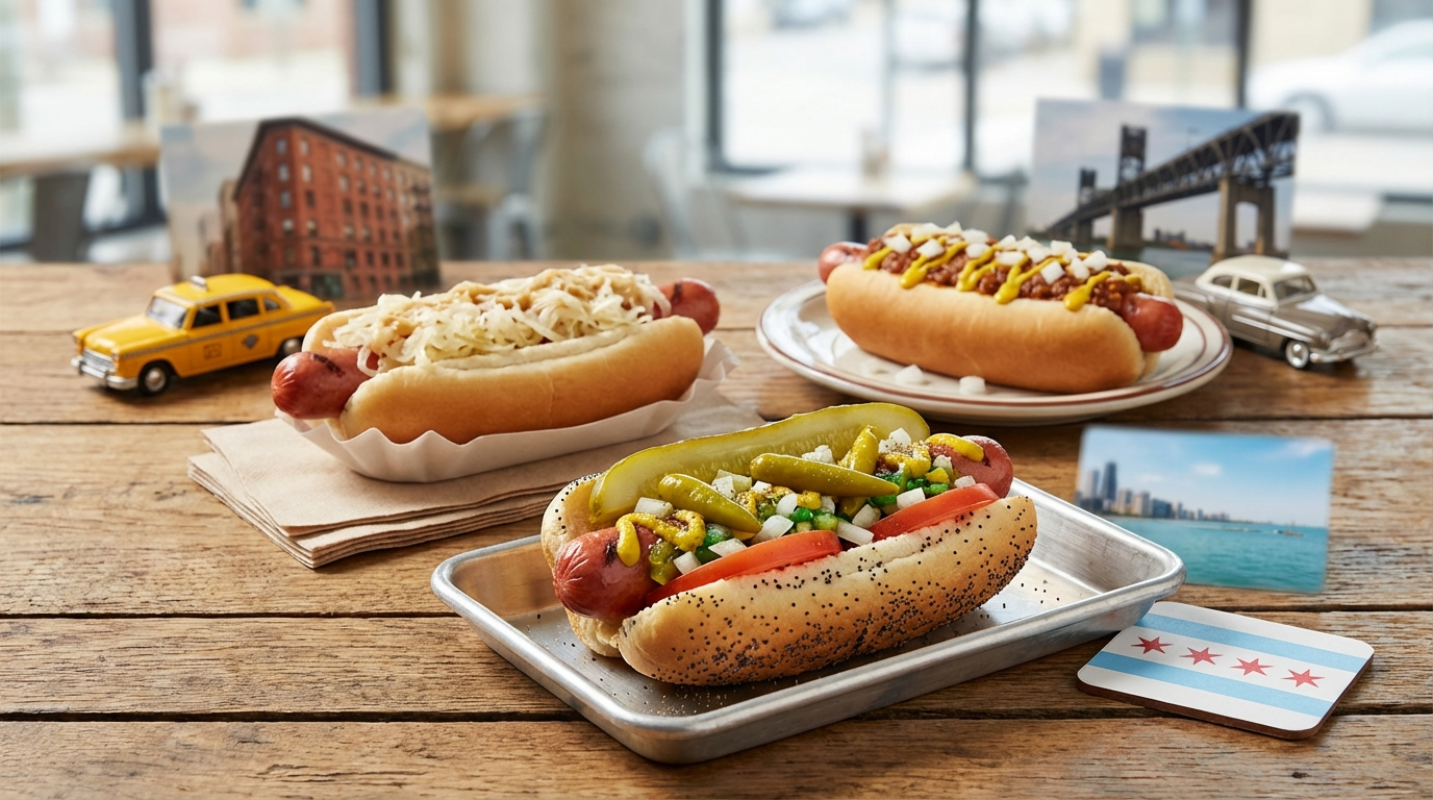
If New York is defined by its speed, Chicago is defined by its dogma. The Chicago-style hot dog is arguably the most famous and certainly the most intricate of all regional variations, an active, multi-layered construction often described as "being dragged through the garden."
This isn't just a snack; it’s an architectural marvel. It starts with an all-beef frankfurter, usually Vienna Beef, served in a steamed poppy-seed bun. Then comes the color palette: yellow mustard, chopped white onions, and that infamous, almost neon-green sweet pickle relish. You then add tomato wedges, a dill pickle spear, and two fiery sport peppers. A final dusting of celery salt completes the masterpiece.
What’s missing? Ketchup. That’s the law.
The prohibition of ketchup on a Chicago dog is more than just a preference; it’s a cultural boundary, a litmus test for authenticity. Experts suggest the dog is specifically "built to stay on the dog even when packed into a stadium," meaning the fresh ingredients and structured toppings are needed for high-volume consumption, and ketchup simply gums up the works.
This adherence to tradition is what keeps classic Chicago vendors growing. Iconic spots like Gene and Jude's Red Hot Stand proudly declare their stance with the tagline: "No seats, no ketchup, no pretense, no nonsense." For a slightly more whimsical, yet equally traditional experience, you might pull into Superdawg Drive-In, where the anthropomorphized hot dog mascots, Maurie and Flaurie, have greeted drivers since 1948.
If you’re visiting Chicago, you’ll find that even the char-dog (a grilled version of the Chicago style) must adhere to the same topping rules. It’s a city that takes its frankfurters seriously.
Chicago's Top Hot Dogs
- Gene and Jude's Red Hot Stand: The epitome of tradition; minimalist service, maximal flavor.
- Superdawg Drive-In: An iconic 1948 drive-in experience with classic Chicago dogs.
- Redhot Ranch: Known for its budget-friendly, depression-style dogs served with fries piled right on top.
New York City's Street Carts
Traveling east, we find the hot dog’s relationship with the city shifts dramatically. Although Chicago hot dogs are complicated monuments, the New York City hot dog is an exercise in efficiency and simplicity. This is food designed for perpetual motion, meant to be consumed standing up on a windy corner in three quick bites.
Forget the garden. In New York, the focus is on the frank itself and the speed of service. The classic NYC street dog is often referred to as a "dirty water dog" because it’s kept hot in a steamer bath on a cart, ready for immediate deployment. The key characteristic here is the snap. Whether boiled or grilled, a good New York dog must have that satisfying casing break.
The toppings are minimal and potent: a smear of spicy brown mustard and a choice of either tangy sauerkraut or a sweet, thinly sliced red onion sauce. That’s it. This minimalist approach allows the quality of the all-beef frankfurter to shine through.
This style is a "no-B.S. kind of hot dog," contrasting sharply with the Chicago style's heavy ornamentation. You find these dogs everywhere, from the iconic carts outside Rockefeller Center to the original landmark location of Nathan's Famous in Coney Island, home of the annual competitive eating showdown.
Although the classics like Gray’s Papaya and Papaya King still dominate with their famous "Recession Special" (two dogs and a tropical drink), the NYC scene is also where innovation is often tested. Recent years have seen gourmet concepts emerge, blending global flavors with the classic street food format. Think BKK Hot Dog, offering Thai-inspired sausages, or the inventive PULPO GLIZZY, an octopus-inspired seafood twist. New York proves that even the simplest food can be a testing ground for 2026’s culinary future.
Detroit's Coney Island and the Chili Dog Hegemony
Move inland to the Midwest, and you encounter a style so regionally specific it has sparked a decades-long rivalry: the Detroit Coney Dog. This isn't just a chili dog; it's a specific philosophical approach to chili, meat, and mustard.
The Detroit Coney Dog is defined by three things: a natural casing hot dog that delivers a great snap; a specific, all-meat, bean-less chili sauce; and generous amounts of yellow mustard and diced raw white onion. The chili, sometimes rumored to contain complex spices like cinnamon or even beef heart, is more of a spicy, savory meat topping than a traditional bowl of chili. It’s thin enough to drape but thick enough to cling.
The history of the Coney dog in Detroit dates back to the early 20th century, established by Greek immigrants. Today, the entire Detroit hot dog experience is encapsulated in the infamous "Coney Wars" between two institutions located side-by-side downtown: Lafayette Coney Island and American Coney Island. Locals swear allegiance to one or the other, citing differences in the chili recipe, the quality of the snap, or simply the atmosphere.
Although the two titans battle it out, other establishments are gaining serious traction. Imperial, like, has consistently been named "Best Hot Dog" in recent local awards, praised for its perfect balance of snap, sauce, and bun. The Coney Dog’s unique profile accounts for a significant portion of regional hot dog orders in the Midwest, proving that sometimes, the chili is the main event.
Key Characteristics:
- The Dog, All-beef and pork, natural casing for maximum snap.
- The Chili, A thin, proprietary, all-meat, bean-less sauce.
- The Toppings, Always yellow mustard applied before the chili, and finely diced white onion on top.
Unique Styles Gaining National Recognition
Although Chicago, New York, and Detroit dominate the conversation, many other cities are making strong claims for hot dog fame, often by introducing radical, yet delicious, local elements. These emerging styles prove that the hot dog remains a dynamic platform for innovation, driven partly by food tourism and social media exposure.
Take, like, the Seattle Dog. This style, which started gaining traction in the 1980s, is perhaps the most unexpected of all. It features a grilled Polish sausage located in a toasted bun, topped with a generous layer of cream cheese and grilled onions. Yes, cream cheese. It sounds bizarre, but the combination of the smoky sausage, the sweet, caramelized onions, and the cool, tangy cream cheese has made it a late-night street food sensation that has spread far beyond the Pacific Northwest.
Another important style is the Sonoran Dog, dominant in Arizona and the American Southwest. This dog takes indulgence to the extreme: the frankfurter is wrapped in bacon, grilled, and served on a bolillo roll (a slightly firmer, sweeter Mexican bread). It’s then piled high with pinto beans, diced tomatoes, onions, mustard, jalapeño sauce, and a drizzle of mayonnaise. It’s less a hot dog and more a feast.
These secondary regional styles are seeing increased national interest. As consumers seek out unique, authentic local experiences, social media and specialty food delivery services are driving these styles into the national consciousness, influencing menus well into 2025.
The Canvas of American Cuisine
We’ve seen that the hot dog isn’t a single dish; it’s a spectrum of deeply personal, localized cuisines. From the precise, architectural masterpiece of Chicago to the creamy indulgence of Seattle, and the chili-soaked rivalry of Detroit, the variety reinforces the idea that tradition, for food, is a powerful force.
But tradition doesn’t mean stagnation. Just as these regional styles were born from immigrant ingenuity a century ago, they are changing today, adapting to new consumer demands. The most significant shift in the current market involves premiumization and alternative proteins.
Premiumization is evident in the quality of the ingredients used. The focus on high-end meats, such as wagyu, and gourmet buns is clear. In fact, specialty buns like brioche accounted for approximately 32% of quality bun sales recently, suggesting consumers are willing to pay more for a superior experience.
.png)