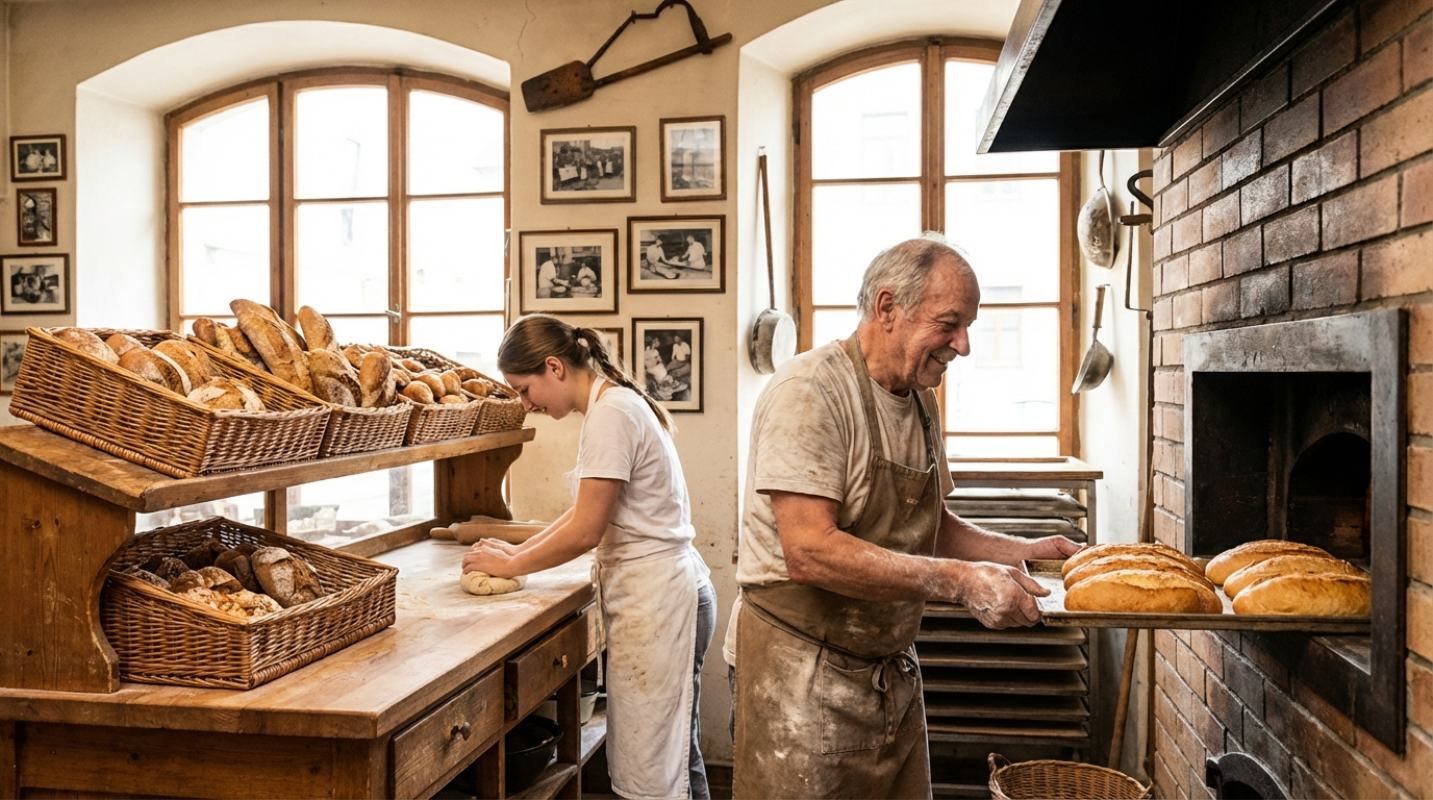
 (Image source: Gemini)
 When you step into a bakery that’s been operating for 100 years, you aren’t just buying a loaf of bread. You’re purchasing a slice of history. You are inhaling the same yeast-and-sugar-laced air that generations before you breathed. That deep, comforting aroma of caramelized sugar and slow-fermented dough is the smell of continuity, a sensory link to the past that few other businesses can offer.
We live in an age of constant churn. Brands rise and fall in a matter of months, and technology promises to disrupt everything from how we communicate to how we eat. Yet, these historic bakeries, often tucked into neighborhood corners or standing proudly on main streets, continue to thrive. They are the cultural anchors of their communities, surviving wars, depressions, recessions, and global pandemics through a fierce dedication to quality and an unwavering focus on tradition.
So, how do they do it? What’s the secret recipe that allows a business dealing in perishable goods to outlast empires? We’re going to explore the mechanics behind their longevity, the iconic products that define their decades, and the important role the newest generation plays in securing their future.
How Tradition Meets Modernity
The core challenge for any generational business is mastering the balancing act. How do you maintain the authenticity that made you famous without becoming a dusty museum piece? It’s a tightrope walk between honoring the great-grandparents who started the shop and appealing to the Gen Z customer who expects seamless digital ordering and ethical sourcing.
The most successful legacy bakeries understand that tradition isn't just about the product itself; it’s about the process.
Take La Segunda Central Bakery in Tampa, Florida. Founded in 1915, they are famous for their Cuban bread. For four generations, they have refused to compromise the arduous, slow, 8-to-10-hour fermentation process that gives the bread its unique texture.¹ Although competitors might automate, La Segunda sticks to tradition, even using the iconic palmetto leaf laid across the dough before baking. This seemingly small detail acts as a powerful differentiator. It tells the customer, "This loaf is authentic."
Meanwhile, across the Atlantic, Hobbs House Bakery in the UK, operating since 1920, demonstrates that modernization means more than just a new website. The fifth generation there has driven a major strategic shift, achieving B Corp status in 2024. This focus on social and environmental performance, focusing on sustainability and ethical sourcing, is what attracts the modern consumer. They diversified their revenue streams dramatically, moving beyond retail shops to include a popular cookery school and a large wholesale division. This approach shows that resilience is often found in diversification, not just stubborn adherence to the original model.
The real threat to these businesses isn't market competition; it's often psychological. Expert analysis suggests that the biggest barrier to longevity is the reluctance of the current generation to plan for succession. In Europe, hundreds of thousands of businesses require succession solutions, yet many owners over 60 procrastinate because "thinking about succession means thinking about your own demise."² Successful transitions, like those at La Segunda and Hobbs House, require nurturing a deep bench of eager successors and sharing the responsibility for the company’s future early on.
Iconic Offerings
What makes a bakery product iconic? It’s usually something that cannot be easily replicated by mass production or by a competitor with a slightly newer oven. It is often tied to a proprietary ingredient, an ancestral technique, or even a piece of equipment that is now irreplaceable.
Consider the French approach. At Gosselin Bakery in Paris, founded in 1896, the approach is simple: resist modern adaptation entirely for the core product. The current head, Philippe Gosselin, insists on using a family heirloom sourdough starter and following a procedure manual established over a century ago. This focus on the "golden triangle" - crisp crust, moist crumb, and lasting sweetness - is their competitive edge. If you want that specific, perfect baguette, you must go to Gosselin.
In New York’s Little Italy, Café Ferrara, established in 1892, specializes in Italian classics like cannoli and sfogliatella. When you bite into a Ferrara cannoli, the shell shatters instantly, giving way to a rich, creamy filling. This specific texture is the result of decades of perfecting the frying temperature and dough composition. The fifth generation balances this heritage with the necessity of innovation, introducing seasonal offerings and, importantly, embracing e-commerce. You can now order their famous Italian cheesecake and have it shipped nationwide.
These signature items define the bakery’s brand identity, but also serve a practical function. They establish a floor for quality. If the sourdough starter has been fed daily for 100 years, you can’t suddenly cut corners without ruining the legacy. The product itself becomes the ultimate quality control mechanism.
Community Cornerstones
A historic bakery is more than a commercial enterprise; it’s a living museum and a community living room. Think about your own neighborhood. Where do the older residents meet in the morning? Where do people pick up a cake for a milestone birthday? The bakery often fills that social vacuum.
These establishments serve as local historians. The staff often knows the names, life milestones, and even the regular orders of everyone who walks through the door. They witness neighborhood shifts, economic booms, and demographic changes, acting as silent, flour-dusted observers.
In neighborhoods that face gentrification or rapid change, the historic bakery provides stability. It’s the one place where the pricing might not have skyrocketed quite as fast, or where the decor remains comfortably familiar. They often support local causes, hire apprentices from the local area, and preserve local customs simply by being the place where those customs are enacted.
This deep integration means that when a historic bakery faces a crisis, the community rallies. It’s not just a business closing; it feels like losing a piece of the neighborhood’s identity. That emotional investment is a powerful form of insurance, making sure that customers remain loyal even when the new, trendy patisserie opens up down the street.
The Future Proof Pastry
If tradition is the engine, then innovation is the fuel that keeps these legacy bakeries running in 2026. The next generation isn't interested in simply preserving a relic; they want to evolve a viable, forward-thinking business.
One fascinating development is the "neo-boulanger" movement, particularly strong in Europe. These young bakers are modernizing the create not by inventing new flavors, but by returning to the deepest traditions. They focus intensely on long fermentation (up to 48 hours) and the use of sourdough, producing bread that is more flavorful, more nutritious, and easier to digest. It’s modernization through radical tradition.
For the American and UK markets, future-proofing means digital adoption and strategic growth. The fourth generation at La Segunda didn't just maintain the shop; they invested heavily in branding and scaled their wholesale operation to ship over 20,000 loaves daily across the nation.³ They transformed a local shop into a multi-channel brand. Café Ferrara, too, expanded its reach exponentially through its online store.
Where to Find the Best Historic Bakes
- For the Ultimate Cuban Bread, La Segunda Central Bakery (Tampa, USA). Look for the palmetto leaf baked into the top of the loaf.
- For Italian Classics, Café Ferrara (New York, USA). Try the cannoli or the traditional Italian cheesecake, available for national shipping.
- For Sustainable Sourdough, Hobbs House Bakery (The Cotswolds, UK). Check out their B Corp-certified organic loaves and cookery courses.
- For the Parisian Baguette, Gosselin Bakery (Paris, France). Experience the result of over a century of unwavering adherence to the "golden triangle" of French bread.
The incoming generation often brings the necessary business acumen - the ability to handle digital marketing, supply chain sustainability, and wholesale logistics - that their ancestors, focused solely on the neighborhood shop, never needed. They are not merely caretakers; they are strategic operators.
These historic shops are far from relics. They matter, changing parts of our culinary culture, proving that while technology changes everything, some things - the taste of real butter, the smell of fresh yeast, and the comfort of tradition - are timeless. They remind us that true longevity comes not from resisting change, but from knowing exactly which parts of your history are worth fighting to protect.
Sources:
1. La Segunda still bakes bread according to family tradition
2. The Succession Crisis: Why So Many Family Businesses Fail to Plan for the Future
.png)