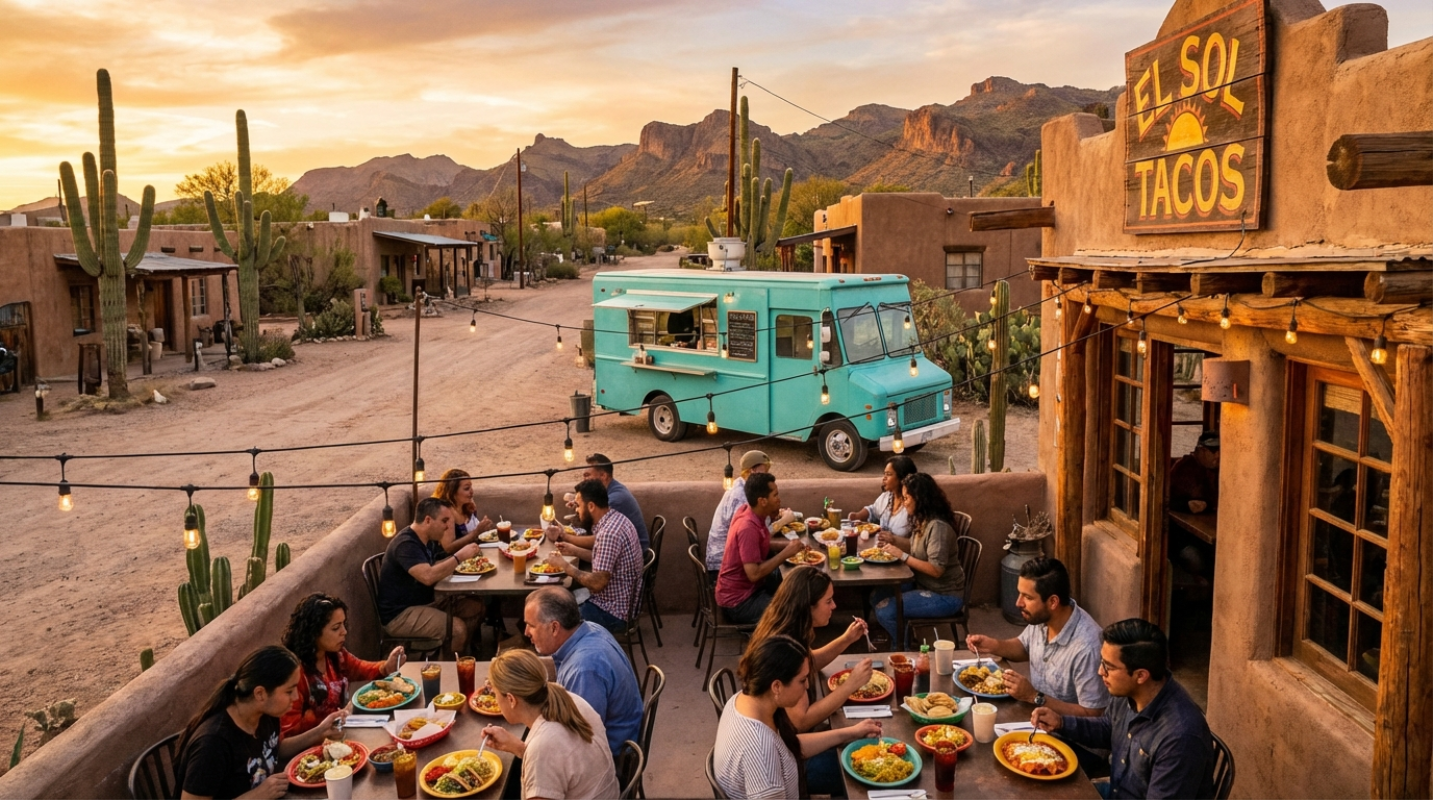
 (Image source: Gemini)
 Forget what you think you know about Mexican-American food. If your mind immediately jumps to a chain restaurant or a standard border town taco stand, you’re missing out on one of the most dynamic, historically rich, and frankly delicious culinary scenes in North America. We’re talking about the desert towns.
The American Southwest desert is not a barren space; it’s a cradle of culture. For centuries, this region has been where Spanish colonial routes, Indigenous agriculture, and Mexican heritage collided, creating a flavor profile distinct from anything you’ll find along the coast or deep in Texas. This isn’t just Tex-Mex, either. This is Sonoran-Mex, New Mexican high-altitude spice, and modern desert fusion.
These desert kitchens rely heavily on what the local environment provides: ancient grains, specific chiles, and slow-cooking methods perfected to handle the arid heat. We’re moving beyond the expected. This guide spotlights the true culinary champions of the desert, proving that the best Mexican-American cuisine often flourishes in the most surprising, sun-baked places.
Tucson, Arizona, A City of Gastronomy Champion
Tucson doesn’t just serve great food; it serves history on a plate. This city has roots that run exceptionally deep, tracing continuous agriculture back over 4,000 years, thanks to Indigenous communities and the life-giving Santa Cruz River.¹
It’s this unparalleled historical depth that earned Tucson the prestigious title of the first UNESCO Creative City of Gastronomy in the United States back in 2015. So what does this designation actually mean for your dinner plate? It means local chefs aren’t just cooking Mexican food; they’re cooking Arizona-Mex, a blend of Native American, Spanish colonial, and Northern Mexican influences.
Sonoran Staples and Heritage Grains
The defining characteristic of Tucson’s food is its strong connection to the Sonoran Desert, which spills over the border from Mexico. You’ll find dishes here that are rare elsewhere. Think carne seca, beef dried in the intense desert sun before being shredded and rehydrated, or the use of chiltepin peppers, tiny, incredibly potent wild chiles.
The city is also famous for championing heritage ingredients like White Sonora wheat, which was brought to the region by Spanish missionaries centuries ago. Modern innovators like Zio Peppe are using this heritage grain in unexpected ways, even in their pizzas and mesquite-flour pastas.
If you want the definitive taste of Tucson history, you must visit El Charro Cafe. Opened in 1922, it’s a century-old institution and the claimed birthplace of the chimichanga. Its longevity and focus on the traditional Sonoran style make it an absolute mandatory stop for anyone serious about desert cuisine.
Palm Springs and the Coachella Valley's Modern Twist
Traveling west to the Coachella Valley, the culinary climate shifts dramatically. Palm Springs, La Quinta, and Indio offer Mexican-American food that reflects the area’s distinct blend of mid-century modern luxury, resort culture, and agricultural output.
Here, the cuisine is less about centuries of tradition and more about refinement and presentation. The desert aesthetic influences the dining experience. Think bright, airy spaces, expertly crafted cocktails, and ingredient sourcing that takes full advantage of the valley’s unique environment.
Dates, Citrus, and Elevated Plates
The Coachella Valley is famously one of the largest date-producing regions in the US. Smart chefs integrate this local sweetness into their savory dishes, perhaps using dates in marinades for pork shoulder or as a surprising component in a mole. The region also provides excellent citrus, which shines in delicate ceviches and complex sauces.
You’ll find a mix here. On one end, you have long-time local favorites like Pueblo Viejo Grill in Indio, praised by locals for its generous portions and "next level" salsa. On the other end, you have the elevated, Mexico City-inspired concepts.
Palm Springs is home to sister restaurants Tac/Quila and Clandestino, which serve refined dishes like short rib enchiladas and innovative ceviche preparations. These spots cater to a sophisticated palate, proving that desert Mexican-American food can be just as sleek and modern as the mid-century architecture surrounding it. If you’re looking for high-quality tequila and a fantastic happy hour, places like El Jefe (inside The Saguaro Hotel) offer that funky, laid-back resort vibe paired with excellent tacos.
New Mexico's High-Altitude Flavor Profile
When discussing desert cuisine, you cannot skip New Mexico. This region is fundamentally different; it doesn’t serve Mexican food or Tex-Mex. It serves New Mexican food, a category entirely unto itself, defined almost solely by one ingredient: the Hatch green chile.
Grown almost exclusively in the rich soil of the Hatch Valley, these chiles are the cultural and culinary cornerstone of the state. They possess an earthy, smoky quality, coupled with a heat level that can range from mild Anaheim to blistering Big Jim. Every August, the state is blanketed in the unmistakable aroma of roasting green chiles, a ritual that signals the heart of the harvest season.
Red or Green? The Cultural Imperative
If you order food in Santa Fe or Albuquerque, you will be asked the most important question in the region: “Red or Green?” This refers to the chile sauce you want smothering your enchiladas, burritos, or carne adovada. Red chiles are the ripened, dried version of the green, offering a deeper, sweeter, and more complex burn.
The flavor profile here is earthy, smoky, and often relies on slow-cooked preparations. Take carne adovada, pork marinated and simmered for hours in a thick, rich red chile paste. Places like Mary and Tito’s in Albuquerque, recognized with a James Beard America's Classics award, are famous for their slow-burning red chile sauce.
Although demand for these precious chiles is soaring nationally, putting pressure on supply and driving prices up (predicted to rise about 10% annually going forward), the focus on authenticity remains strong in New Mexico.² When you eat here, you are tasting a flavor profile that has been untouched by trends, relying instead on high-altitude terroir and historical recipes. Santa Fe’s The Shed Restaurant, serving since 1953, is the perfect place to experience this historical heat in an old adobe setting.
Unexpected Culinary Stops
Although the major hubs of Tucson, Palm Springs, and Albuquerque get the most attention, the desert’s culinary excellence isn’t confined to these cities. Smaller towns and unexpected oases are also making waves, often driven by dedicated chefs looking to escape the high rents and saturation of urban centers.
Consider El Paso, Texas. Sitting right on the border, El Paso’s L&J Cafe has been serving classic borderlands comfort food since 1927. It offers a different, deeply traditional Tex-Mex experience, focused on hearty, soul-warming burritos and soups that reflect the unique flow of ingredients and people across the Rio Grande.
You might also find culinary dedication in places like Marfa, Texas, where the isolation itself breeds creativity. The chefs who choose to operate in these smaller, more remote desert markets often have intensely personal connections to the ingredients, leading to incredibly authentic and focused menus. Their success hinges entirely on quality and community support, which makes dining there a truly unique experience.
Finding these under-the-radar spots requires a little effort, but the payoff is worth it. Look for places with only local reviews, or spots that specialize in one or two items (e.g., a place that only sells tamales on Wednesdays). That specialization often signals deep expertise.
Top Recommendations
- Tucson, AZ, El Charro Cafe: Needed stop for Sonoran cuisine, famous for carne seca and the chimichanga.
- Santa Fe, NM, The Shed Restaurant: Classic New Mexican cuisine in an adobe setting; order anything smothered "Christmas style" (both red and green chile).
- Palm Springs, CA, Tac/Quila: Elevated, refined Mexican plates perfect for a modern desert dining experience.
- Albuquerque, NM, Mary and Tito’s: Try the carne adovada, a masterclass in slow-cooked red chile flavor.
The desert Southwest offers a remarkable spectrum of Mexican-American cuisine, far richer and more diverse than most travelers realize. You have the ancient, earth-driven flavors of Tucson’s UNESCO-recognized Sonoran style, the fiery, high-altitude spice of New Mexico’s Hatch chile culture, and the sleek, ingredient-focused modern fusion of the Coachella Valley.
Sources:
1. Tucson: UNESCO City of Gastronomy
2. Best Mexican-American Restaurants in US Desert Towns 2024 Expert Reviews
.png)