 (Image source: Gemini)
 Forget the white tablecloths and hushed dining rooms. If you truly want to know a city, you need to follow your nose to the nearest corner stall. This is where the real history is cooked, where recipes are passed down through generations, and where the pulse of the local economy beats fastest. Street food isn’t just fast food; it is the soul of a destination served on a paper plate.
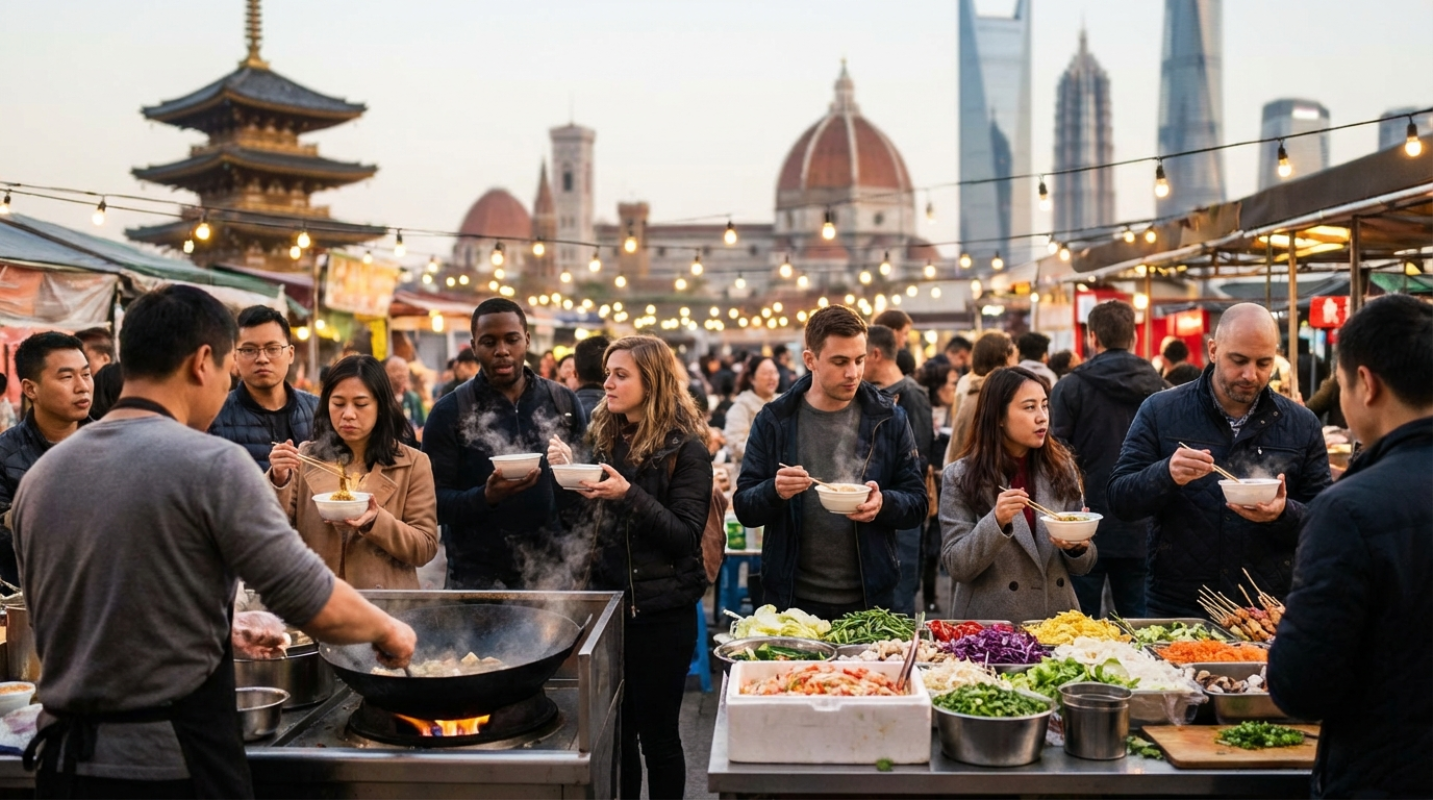
These signature dishes - the perfectly seasoned taco, the steaming bowl of noodles, the impossibly crispy fritter - are the culinary anchors that define a city’s global identity. They are affordable, they are immediate, and they offer a sensory explosion that fine dining simply cannot replicate. You hear the rhythmic chopping, you see the flash of the wok flame, and you taste the concentrated history of the place.
This appetite for authenticity is driving a massive global market. Consumer demand for experiential dining and value for money has pushed the street food market to an estimated value of USD 249.55 billion in 2024.¹ When you consider global inflation and the cost-of-living crisis, it makes perfect sense that affordability is a key driver for consumers worldwide.³ Street food isn't just delicious; it’s smart.
Bangkok and Hanoi – Masters of the Wok and Noodle
Asia remains the undisputed champion of street food culture, and nowhere is this more apparent than in Thailand and Vietnam. The sheer volume, quality, and variety on offer here are staggering.
Take Bangkok, a city consistently called one of the greatest street food destinations in the world. The chaotic energy of Yaowarat Road in Chinatown is legendary, a symphony of sizzling oil and sweet chili smoke. The signature dish, of course, is Pad Thai. But the authentic version you find sizzling roadside is nothing like the gloppy takeout you know. It’s a perfect balance of sour lime, salty fish sauce, sweet sugar, and crunchy peanuts. Don't stop there, though; you haven’t truly experienced Bangkok until you’ve chased that spice with sticky rice and perfectly ripe mango.
But the city is changing. To manage the immense popularity and the necessary public order, the Bangkok Metropolitan Administration (BMA) introduced new criteria in 2024. Vendors now face a 12-point assessment focusing heavily on hygiene and public cleanliness.³ This means you should expect to see merchants wearing clean aprons, hair nets, and closed-toe shoes. It’s a necessary step to balance tradition with modern standards.
A short flight away, Vietnam offers a different kind of street food mastery: one built on freshness and herbs. Although Hanoi is famous for its elegant, deeply aromatic Pho Bo (beef noodle soup), it's Ho Chi Minh City (Saigon) that often steals the top spots in expert rankings, even earning Michelin Guide Bib Gourmand recognition for multiple street vendors.⁵ The other ubiquitous champion is the Banh Mi, a relic of French colonialism transformed into a masterpiece. It’s a crunchy baguette stuffed with pâté, cold cuts, fresh cilantro, pickled carrots, and chili. It’s delicate, herbaceous, and utterly addictive.
Contrasting these two giants, you see the difference between Thai street food’s sweet-spicy complexity and the light, clean, intensely herbaceous precision of Vietnamese street fare. Both are mandatory stops on any serious culinary tour.
Mexico City and Lima – From Tacos Al Pastor to Ceviche
Moving across the globe, Latin America provides some of the boldest, most flavorful street food experiences imaginable, driven by centuries of culinary tradition.
Mexico City is a foodie’s paradise, and the star of its street scene is undoubtedly the Tacos al Pastor. This dish is an art form: marinated pork stacked on a vertical spit (like a shawarma), caramelized by the heat, and shaved directly onto a small corn tortilla. It’s typically topped with pineapple - sliced dramatically from the top of the spit - cilantro, and onion. This isn't just dinner; it’s a performance. Beyond the savory, you’ll find street vendors serving hot, crispy churros, often from institutions like El Moro, which has been open since 1935. These vendors are needed, often multi-generational small businesses that preserve community and culture through their food.
Down the coast, Lima, Peru, has successfully elevated street food ingredients to high-end global recognition. Although Peruvian cuisine is famous for its sophistication, the street food scene thrives on coastal freshness. Ceviche, often served street-side, is the perfect example. Raw white fish is cured instantly in leche de tigre (lime juice, chili, onion), providing a burst of flavor and acidity.
Then there are anticuchos: skewers of marinated, grilled beef heart. Although the ingredient might sound intimidating, the final result is tender, smoky, and seasoned with a perfect blend of cumin and aji chili. What’s key about Lima's street scene is the high quality of the raw ingredients, a direct reflection of Peru’s rich biodiversity.
Rome and Berlin – Tradition Meets Modern Fusion
Europe’s relationship with street food is characterized by two extremes: historical tradition and modern, migratory fusion.
In Rome, the necessity of a quick, satisfying meal led to the invention of dishes that are now street classics. You won't find many vendors cooking Pad Thai here; instead, you’ll find needed Roman quick fixes. Take Supplì - fried risotto balls stuffed with mozzarella and sometimes ragù. They are simple, warm, and the perfect grab-and-go snack. The other needed is Pizza al Taglio (pizza by the slice). Sold by weight, this thick-crusted, focaccia-like pizza allows for endless toppings and an authentic, inexpensive Italian meal.
Berlin, by contrast, shows cultural exchange. Its signature street dish is the Currywurst: sliced pork sausage slathered in a ketchup-based sauce seasoned with curry powder. It’s an unlikely, post-war classic. But the true king of Berlin’s street food scene is the Turkish Döner Kebab. Thanks to the city’s large Turkish community, Berlin arguably serves the best Döner outside of Istanbul. This is fusion food at its finest, demonstrating how European cities are balancing historical recipes with the influence of modern migration.
Top Recommendations for Your Next Trip
Planning your itinerary? Although the cities above are mandatory stops, the real secret to great street food is knowing exactly what to seek out. These dishes are so iconic that they are worth the plane ticket alone.
- Mumbai, India, Seek out the Vada Pav. Often called the "Indian burger," it’s a spicy potato fritter served in a soft bun. It was ranked as the signature dish of the city that placed fifth globally in the 2024-2025 "100 Best Food Cities in the World" list.¹⁰
- Istanbul, Turkey, Try Balik Ekmek. This simple, fresh fish sandwich, often served right by the Galata Bridge, pairs perfectly with a crunchy Simit (a sesame-crusted bread ring).
- Ho Chi Minh City, Vietnam, Order the Goi Cuon (fresh spring rolls). These are light, herbaceous, and served with a rich peanut dipping sauce.
Emerging Culinary Hubs and the Future of the Stall
Although the traditional titans like Bangkok and Mexico City hold their ground, cities in emerging markets are demanding attention. Mumbai, India, like, offers an incredible density of street food, from the aforementioned Vada Pav to the complex flavors of Pani Puri (crispy shells filled with flavored water).
What makes a dish truly "signature"? It’s a combination of wide availability, deep historical roots, and, increasingly, viral popularity. Street food must be democratic; everyone must be able to afford it and access it.
But the growth of this market brings necessary challenges, primarily concerning safety. Major cities are actively addressing this. In late 2024, Mumbai’s Food Safety and Standards Authority of India (FSSAI) partnered with local government to train 10,000 street food vendors to improve hygiene and safety standards. That’s a massive undertaking aimed at protecting both the consumer and the vendor.
Likewise, Istanbul introduced a mandate requiring 24-hour audio and video recording in all food establishments, with authorities conducting nearly 200,000 inspections in the first 10 months of 2025. These measures show that while tradition is sacred, the future of street food depends on transparency and hygiene.
Don’t just read about these cities; go taste them. Travel today requires more than just visiting landmarks; it demands immersion. So book that flight, find that corner stall, and let the sizzle and steam guide your next great meal. The world’s best food is waiting for you, and it’s served standing up.