 (Image source: Gemini)
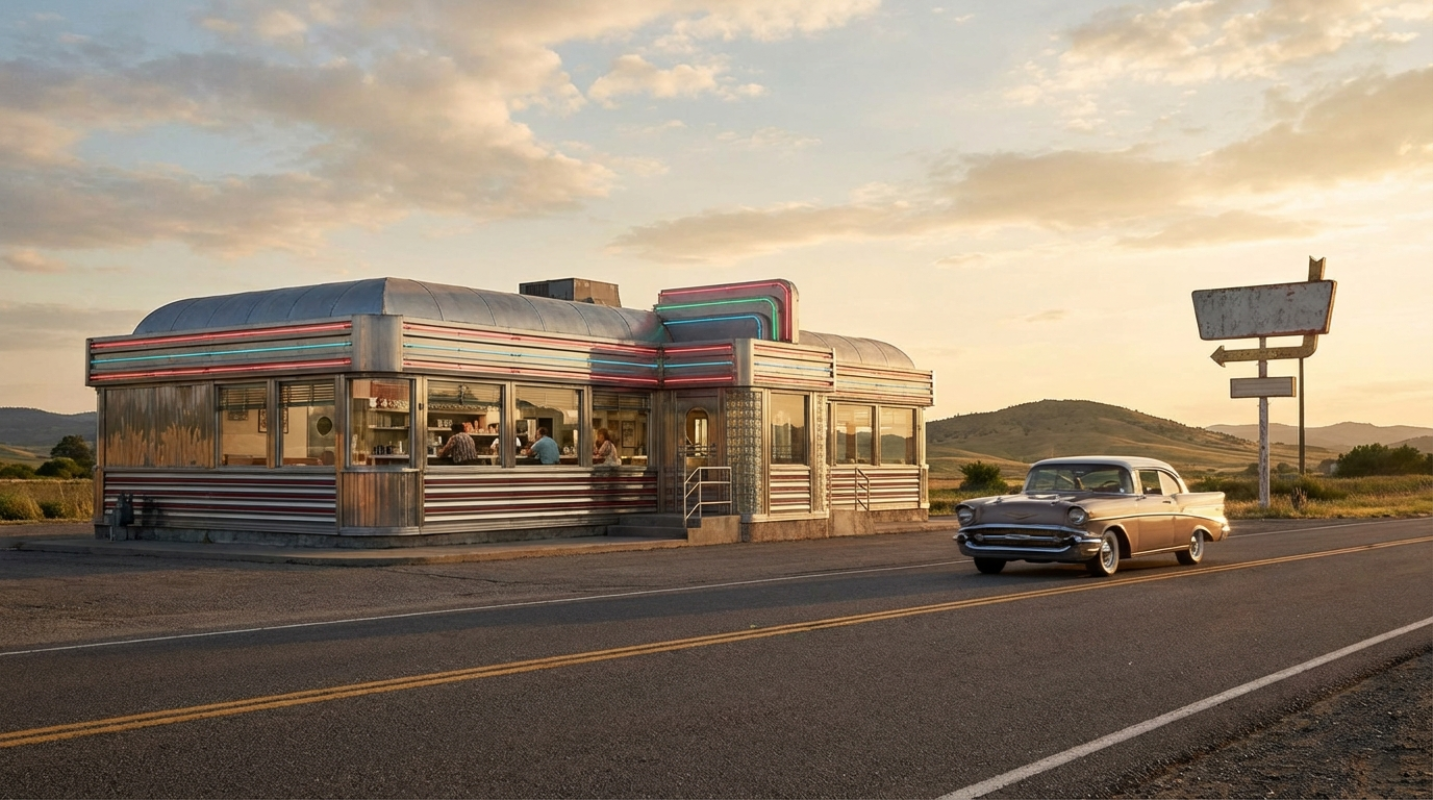
 You know the feeling. You’ve been driving all day, the sun is low, and the endless ribbon of asphalt has blurred into a monotonous gray. Then, you see it: a flash of neon, a curve of stainless steel, and a parking lot dotted with cars that look like they belong in a different decade. You pull over, the screen door gives a satisfying whap, and the smells of hot coffee, griddled onions, and sweet pie hit you all at once. You’ve arrived at a historic diner.
This isn’t just a place to grab a quick bite. These pre-1970s structures, still serving along America’s classic highways, are cultural landmarks. They are time capsules built during the golden age of the American road trip, offering a tangible connection to the past that modern fast-food chains simply cannot replicate. They are monuments to mobility, democracy, and darn good comfort food.
This journey is about more than just finding the best patty melt; it’s about tracing the history of our highways through the architecture and menus of the diners that sustained them. We’re focusing on the resilient relics that cling to iconic routes, from the legendary US Route 66 to the densely packed corridors of the Eastern Seaboard. These places haven’t just survived; they’ve become needed stops on the modern traveler’s itinerary.
Identifying and Preserving the Classic Diner Aesthetic
To truly appreciate a historic diner, you need to understand its DNA. The classic diner aesthetic wasn’t accidental; it was engineered for speed, efficiency, and highway visibility. Think of the shiny exterior. That stainless steel and porcelain enamel wasn’t chosen just for kitsch; it was easy to clean and reflected light, making the building pop against the dark night sky.
The architecture itself tells a story of American innovation. Diners evolved from horse-drawn lunch wagons (first seen in the 1870s) into prefabricated, modular structures, often built by companies like the Worcester Lunch Car Company or the Kullman Dining Car Company. They were factory-built and shipped to the site, ready to open almost immediately. This modular design allowed for rapid expansion during the post-World War II automotive boom, perfectly matching America’s new obsession with the automobile.
Inside, the formula is sacred: long counter seating allowing for quick service and social interaction, vinyl booths lining the walls, and a visible cooking line so you can watch your short-order chef work their magic.
The challenge of preservation today is immense. These structures require constant, specialized maintenance, and the economics of running a small, independent restaurant are brutal. When you see a diner that still looks authentic, you’re looking at decades of painstaking restoration efforts, often championed by historical societies and fiercely dedicated local owners who understand that they aren’t just running a business; they’re holding onto history.
Route 66 Icons
No discussion of highway diners is complete without paying homage to US Route 66, the Mother Road. Here, the diners aren’t just restaurants; they are needed destinations, drawing tourists from around the globe who seek that pure, unadulterated slice of American nostalgia.
The experience is cinematic. You sit down in a booth worn smooth by generations of travelers, drop a quarter into the vintage jukebox, and wait for a plate piled high with comfort. The friendly service matters here; these places thrive on making you feel like family, even if you’re thousands of miles from home.
One of the most remarkable examples of longevity is the Ariston Cafe in Litchfield, Illinois. This institution is celebrating its 100th year in business in 2024, making it the oldest continuously operated restaurant on Route 66. It’s a proof of consistency and quality, having earned a spot on the National Register of Historic Places. If you’re traveling the route, you must stop here for a blue-plate special.
These Route 66 landmarks survive primarily through heritage tourism. Expert analysis indicates that a significant portion of their clientele, often 40% to 60%, are non-local travelers drawn specifically by the route’s history.⁸ This tourism provides an important economic import, yet their viability remains vulnerable. A single bad tourist season or a major highway detour can spell disaster, showing the constant fight to keep the lights on in these corridor communities.
East Coast Classics
Although Route 66 offers spread-out roadside stops, the East Coast, particularly New Jersey and New England, is the birthplace and dense heartland of the modular diner. Here, you find the classic "shiny-domes" located tightly between urban sprawl and old US 1.
The diners here often have a different architectural feel than their Western cousins, reflecting the smaller lots and dense population centers. They’re often more streamlined and compact, like the classic Summit Diner in New Jersey, one of the few remaining examples of the compact 1920s style.
But the East Coast diner faces an immediate, important threat. New Jersey, long known as the "Diner Capital of the World," has seen a staggering loss, shedding an estimated 150 historic diners in the last decade, with only about 500 remaining. The culprits are the usual suspects: soaring food costs, important staffing shortages, and post-pandemic pressures that strain the traditional low-cost diner model.
The preservation fight here has become legislative. In a direct response to the crisis, New Jersey lawmakers are advancing the "Saving Our Diners and Protecting Our Past Act," or the SODA Pop Act. This proposed legislation aims to provide targeted tax breaks and credits to qualifying historic diners, recognizing that without direct financial relief, these cultural anchors will vanish forever. This isn't just about saving buildings; it’s about saving a way of life that simply can’t absorb modern inflation without help.
Finding Authenticity in 2026
If you’re planning a road trip in 2026, you need an approach to separate the genuinely historic from the modern imitation. Plenty of new restaurants adopt the chrome and neon aesthetic, but they lack the soul of the real deal.
How do you vet a true historic diner? Start by looking for the imperfections. A truly historic diner will have the patina of age: the slight wobble in the counter stool, the faded paint on the original signage, the worn-out indentations on the linoleum floor. If the chrome is too shiny, if the menu is printed on a large flat-screen TV, you might be in a reproduction. Look for the modular nameplates from the original manufacturers, like the aforementioned Kullman or Worcester Lunch Car Co.
The role of digital media in sustaining these places is important. Social media and travel blogs are now the primary way these often geographically isolated businesses attract new customers. They rely on you, the traveler, to share their story, post that photo of the perfect stack of pancakes, and spread the word.
To truly support the legacy of these establishments, you need to go beyond the photo opportunity. Order the coffee, buy a piece of pie, and leave a generous tip. These small acts of patronage are what fund the next heating bill, the next roof repair, and the next few years of operation.
Top Recommendations for Authentic Diner Stops
- Ariston Cafe (Litchfield, IL) - The oldest continuously operated restaurant on Route 66. A must-visit for classic American cuisine and history.
- Lou Mitchell's Restaurant (Chicago, IL) - Operating since 1949, this is the classic starting point for any Route 66 adventure, famous for its breakfast and coffee.
- Summit Diner (Summit, NJ) - A beautifully preserved example of a compact 1920s-style diner car, representing the core history of the East Coast module.
Savoring the Past, One Cup of Coffee at a Time
The historic diner is perhaps the most democratic architectural space America ever created. It’s where the trucker sat next to the tourist, the millionaire next to the mechanic, all sharing the same bottomless cup of coffee and the same menu of affordable comfort. It’s a place where social barriers temporarily dissolve under the glow of fluorescent lights.
These chrome temples are more than just stops on the map; they are monuments to the great American impulse to get in a car and see what’s out there. They represent resilience, surviving recessions, highway re-routes, and the shifting tides of culinary fashion.
The necessity of keeping these places alive isn’t merely sentimental. It’s about preserving the physical evidence of our shared history. It’s about making sure that the next generation of road trippers can still pull off the highway, hear that satisfying whap of the door, and know that they’ve stepped into a truly genuine piece of the past. Don’t let the neon go dark. Go find one, sit at the counter, and order another cup. You won’t regret it.
Sources:
1. Ariston Cafe 100th anniversary