 (Image source: Gemini)
 If you think American pizza is just a simple matter of crust thickness, you are wildly underestimating this country’s culinary ambition. We didn't just adopt the Neapolitan tradition; we colonized it, adapted it, and weaponized it with regional pride. Every major city, it turns out, has an origin story told in flour, sauce, and cheese, resulting in a collage of styles that often bear little resemblance to one another.
This isn’t just a food tour; it’s a confident culinary road trip that links the most iconic pizza styles directly to the geography, industry, and immigration patterns that birthed them. We’re moving beyond the generic slice to explore the historical heavyweights of the East, the deeply entrenched local favorites of the Midwest, and the innovative, ingredient-focused creations of the West Coast. Get ready to rethink everything you know about what a pizza should be.
The Original Titan New York Slice and Its Deep Roots
When we talk about the American pizza standard, we are talking about New York. This is the style that defines fast, functional, and fiercely delicious pizza. It all started in 1905 when Gennaro Lombardi opened the first licensed pizzeria in the U.S. in Little Italy, preparing for what would become a national obsession.
The DNA of a true New York slice is unmistakable. It’s large, thin, and hand-tossed, achieving a perfect balance between a crisp edge and a pliable, slightly chewy core. Importantly, the crust is thin enough that you can fold it exactly in half, forming a structural taco that helps quick, on-the-go consumption. This foldable architecture isn’t accidental; it’s a necessity born from the city’s pace.
The flavor profile is determined by high-temperature, gas-fired ovens and the specific ingredients. You’ll find low-moisture, full-fat mozzarella, often layered over a simple, slightly acidic tomato sauce. Although many slices today are baked in modern ovens, the historical reliance on coal and, later, gas-fired brick ovens is what gives the crust its signature char and chew.
Although the classic $3 slice remains the city’s backbone, the New York pizza scene continues to evolve. In the mid-2020s, the artisanal movement has pushed the boundaries, resulting in styles like the thicker, saucier Grandma slice, or the highly sophisticated, Neapolitan-inspired pies that use specialized imported flour. For proof that the city remains the epicenter of quality, consider that Una Pizza Napoletana in New York was named the Best Pizzeria in the United States for 2024.³ It’s clear the original titan hasn’t ceded its crown; it’s just expanded its empire.
Chicago's Deep Dish vs. Tavern Style
Mention Chicago pizza anywhere outside the city limits, and the conversation immediately turns to Deep Dish. This towering, majestic creation is the city’s global ambassador, a dish that often sparks heated debate about whether it even qualifies as "pizza" at all.
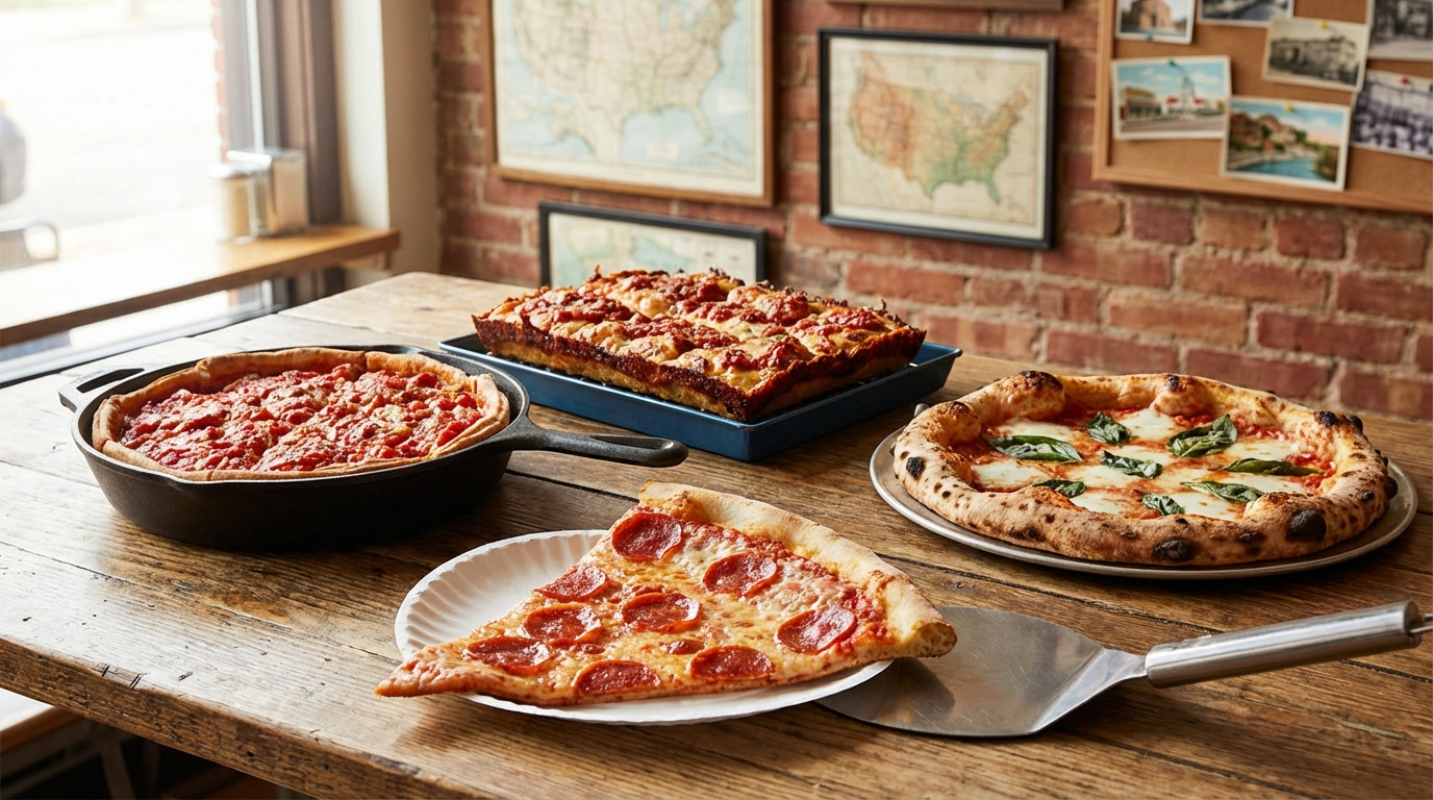
Deep Dish was invented in 1943 at Pizzeria Uno by Ike Sewell and Richard Riccardo. It’s baked in a deep, round, oiled pan, giving the crust a high, buttery, flaky edge that resembles pie pastry more than bread. Because the bake time is long (sometimes 40 to 50 minutes), the ingredients are assembled "inside-out." You’ll find the cheese and toppings layered directly against the crust, followed by a thick, chunky, uncooked tomato sauce applied on top. This prevents the cheese from scorching during the extended stay in the oven. It is rich, it is hearty, and it demands a fork. It is, undeniably, a delicious casserole.
But here’s the confident assertion you need to hear: Deep Dish is the tourist pizza. The real everyday pizza of Chicago is Tavern Style.
Tavern Style is the culinary contradiction to its famous cousin. It features a cracker-thin crust, often rolled rather than tossed, baked until shatteringly crisp, and typically cut into small squares, known locally as the “party cut.” This style originated in post-WWII working-class taverns, where the pizza served as a cheap, easy, salty snack meant to encourage beer sales. Cutting it into squares made the pieces easier to share and fit onto a small bar napkin.
If you want to eat like a true Chicagoan, you skip the deep well and order the thin crust, laden with toppings and cut into geometric squares. It’s fast, incredibly satisfying, and the preferred style among locals, proving that sometimes, the most famous food isn't the most beloved one at home.
The West Coast Wave California Style and the Artisan Movement
The West Coast, particularly California, didn’t inherit a pizza tradition; it invented one in the 1980s. Although New York and Chicago focused on structural integrity and classic Italian-American ingredients, California chefs looked at the pizza as a blank canvas for culinary experimentation, emphasizing fresh, seasonal, and often unexpected gourmet toppings.
Pioneers like Ed LaDou and Wolfgang Puck, heavily influenced by the farm-to-table movement at places like Chez Panisse, defined the original "California Style." They championed the thin, wood-fired crust but loaded it with components that would send a Neapolitan purist into cardiac arrest: duck sausage, smoked salmon, goat cheese, or cilantro. This style wasn’t about folding or fighting the sauce; it was about showing the quality of the regional produce.
Today, the West Coast wave continues to push innovation, blending international techniques with local ingredients. The newest trend gaining traction is the Roman Pizza style, specifically Pizza al Taglio. This rectangular, highly-hydrated dough yields a crust that is incredibly light and airy, often cut with scissors (al taglio means "by the cut") and topped with minimalist, high-quality ingredients.
You’ll find that the West Coast is obsessed with the quality of the dough itself - sourdough starters, long fermentation times, and specialty flours are the norm. Whether it’s a Neo-Neapolitan pie with a modern twist or an internationally inspired creation incorporating Asian or Latin American flavors, California pizza is always about upgrade and reinvention. It treats pizza not as comfort food, but as fine dining.
Emerging Icons Detroit, St. Louis, and the Next Frontier
Although New York and Chicago define the past century of pizza, the last decade has been dominated by emerging regional styles that are now achieving national recognition. Two stand out for their distinct, non-traditional approaches: Detroit and St. Louis.
Detroit Style is, arguably, the hottest pizza style in the U.S. today.² Its origins are wonderfully industrial. In the 1940s, Gus Guerra, a tavern owner at Buddy's Rendezvous, began baking Sicilian-style pizza in repurposed rectangular blue steel utility trays used by local auto factories.
The resulting pizza is thick, rectangular, and has a light, airy, focaccia-like crumb. The key to Detroit style is the cheese: Wisconsin brick cheese is spread all the way to the edge of the pan. As the pie bakes, the cheese caramelizes against the oiled steel, creating a signature crispy, dark brown crust known as "frico." The sauce is traditionally applied in thick "racing stripes" on top of the cheese, completing the visual and textural masterpiece. It’s structural, it’s cheesy, and it’s deeply satisfying.
Then there is St. Louis Style, perhaps the most polarizing pizza in America. It starts with an unleavened, cracker-thin crust, which remains completely firm throughout the bake. The defining ingredient is Provel, a processed cheese blend of cheddar, Swiss, and provolone that melts smoothly but has a unique, slightly tangy flavor and texture. Like Tavern Style, it is always cut into squares, but its firm crust and reliance on Provel make it a truly unique, and often controversial, regional icon.
These emerging styles prove that American pizza culture is anything but static. They show that local history, industrial accidents, and regional ingredient availability continue to drive innovation.
Tasting America One Slice at a Time
We’ve covered thousands of miles in just a few hundred words, traveling from the foldable street food of Manhattan to the buttery, industrial pans of Detroit. What’s clear is that American pizza is less a single food item and more a collage of adaptation, local history, and fierce civic pride.
The difference between a New York slice and a Chicago Tavern square isn't just the crust; it's a difference in lifestyle, climate, and how people socialize around food. You can taste the history of Italian immigration in the Bronx, the industrial grit of the Motor City, and the agricultural bounty of California, all in a single bite.
So the next time you order a pizza, don't just ask for pepperoni. Look closely at the crust, the cheese, and the way it’s cut. Ask yourself where that specific style came from, and what local story it’s telling. Because tasting America means tasting one delicious, regionally specific slice at a time.
Sources:
1. PMQ Pizza Power Report 2025: The Top 10 Trending Pizza Styles for the Coming Year