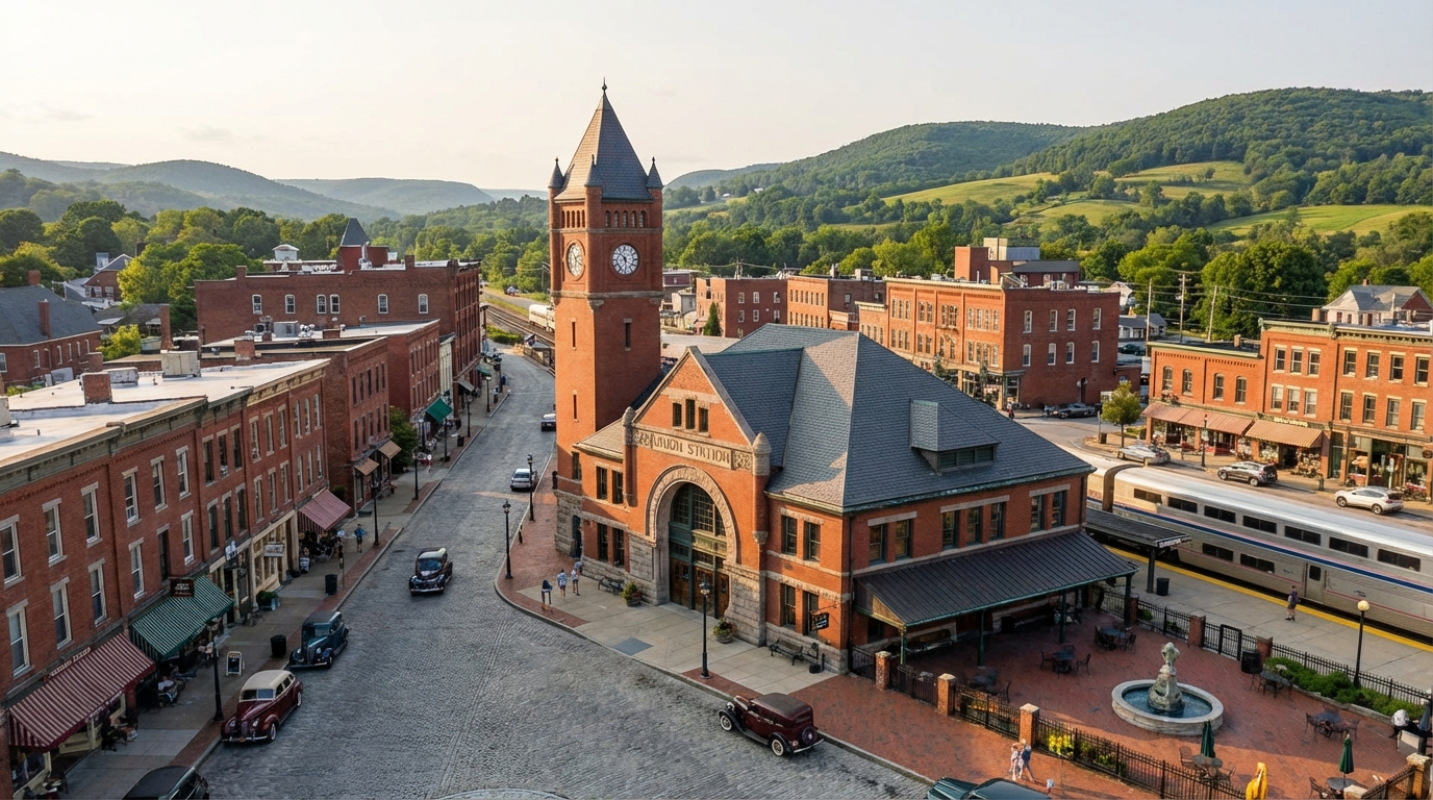
 (Image source: Gemini)
 If you’ve ever driven through a small town in America and felt that powerful sense of place, a feeling that everything radiates outward from a single point, chances are you were standing near the old railroad tracks. The historic train depot isn’t just a beautiful piece of architecture; it’s the original beating heart of the community. It’s where your grandparents arrived, where the mail was sorted, and where commerce began.
These structures created towns out of thin air. They dictated the layout, the architecture, and the flow of life for generations. Today, decades after passenger rail declined, these depots are experiencing a spectacular renaissance. They are moving out of the preservationist’s dusty scrapbook and into the center of modern urban planning, proving that the past is often the best foundation for future growth.
The Iron Horse Catalyst
Think about the sheer impossibility of settling the American West before the mid-19th century. If you couldn't haul it, you didn't have it. Then came the Iron Horse. The railroad wasn't just transportation; it was the ultimate tool for Manifest Destiny, rapidly expanding networks between the 1860s and the 1920s.
The moment surveyors hammered a stake into the prairie and declared, "Here will be a station," the land instantly gained value. The depot was the ultimate catalyst for community creation. It was the first civic structure, the place where all lines of communication, commerce, and passenger flow converged.
Why did towns pop up around them? Because the depot was the only way to get goods in or grain out. It functioned as the town’s first bank, post office, and telegraph office. If you were a merchant, you built your store facing the tracks. If you were a hotelier, you would have built your lodging directly across the street. The depot wasn’t just a building; it was the important economic engine that provided the necessary momentum for a transient camp to become a permanent town.
Anatomy of a Boomtown
If you want to understand how a railway town was born, look at the architecture. The style of the depot often tells you exactly when the town peaked and how much money the railroad company was willing to spend on its image.
Railroad companies were masters of branding. They often employed famous architects to design structures that projected permanence and sophistication, regardless of the town's size. You’ll find everything from the heavy, stone-arched strength of Richardsonian Romanesque in the Northeast and Midwest, designed to evoke European grandeur, to the sweeping red-tiled roofs and stucco of Mission Revival styles dominating the Southwest. These regional variations weren't accidental; they were carefully planned architectural signatures designed to welcome and impress travelers.
The depot’s location dictated everything else. The tracks typically ran east-west or north-south, and the town's main street, often called Depot Street or Railroad Avenue, ran perpendicular to the tracks. This layout created a distinct "front" of the town, facing the tracks, and a less glamorous "back," often reserved for industrial yards and warehouses.
Take a town like Williams, Arizona, the gateway to the Grand Canyon Railway. Its entire downtown is compressed against the original depot and tracks. The hotels, diners, and souvenir shops are all clustered tightly around the station, perfectly illustrating how the railroad’s necessity created a dense, walkable, and commercially focused center. That original infrastructure, still visible today, is the town's structural blueprint.
The Mid-Century Shift
The reign of the train depot was long, but it wasn't eternal. The mid-20th century brought two seismic shifts that nearly killed the depot-centric town.
First came the jet engine, drastically cutting long-distance passenger travel time. Second, and far more damaging to local commerce, was the Interstate Highway System, kicking off after World War II. Suddenly, freight and people didn't need the central depot hub anymore. They could drive right past the town center on a shiny new freeway.
The economic downturn was brutal. When the passenger trains stopped and the tracks fell silent, the downtowns that had been built for rail traffic entered a slow, painful ghost town phase. Businesses are facing the tracks closed. Grand stations that had once welcomed thousands of travelers daily became neglected, decaying symbols of a bygone era.
Yet, many communities refused to let go. This pivot to preservation wasn't always driven by nostalgia; often, it was driven by pragmatic recognition of the building’s historical and architectural value. These structures were, after all, built to last. Many were constructed of heavy stone and brick, designed to accommodate massive daily traffic. As preservation experts note, these buildings have "good bones" and were "built with the intention of welcoming tens of thousands of people per day," making historic renovation an "economically and environmentally" sensible choice over new construction.¹
Modern Momentum
Fast forward to 2026, and the trend is clear: the most successful small-town revitalizations are centered around the historic depot. This isn’t just about putting a plaque on a building; it’s about adaptive reuse, turning relics into revenue generators.
The dominant trend is the conversion of these architectural gems into mixed-use destinations that anchor downtown revitalization efforts. The goal is to create dynamic spaces that honor the past while serving modern community needs.
We’re seeing large, grand stations transformed into luxury hotels and tech hubs. Like, the massive $1 billion investment in Detroit’s Michigan Central Station by Ford Motor Company transformed the abandoned 16-story depot into the centerpiece of a new innovation district.
But the smaller towns are also seeing major benefits. In places like Oxford, Alabama, a smaller, 140-year-old depot recently underwent a $1.4 million refurbishment. It opened in late 2024 as the Spring Street Station, a new restaurant and community venue. These projects are often financed using historic rehabilitation tax credits, which developers find "very good financially" for breathing life back into the structures.²
The economic impact is staggering. Preserving railroad architecture is now recognized as a powerful development tool. It drives heritage tourism, which in Texas alone contributes billions in annual spending.
Top Recommendations for Depot Visitors
If you're planning a trip focused on railway history, here are a few spots where the historic depot is the main event
- Denver Union Station integrates a luxury hotel (The Crawford) with active transit and high-end dining. It successfully handles approximately 10,000 visitors daily.
- Salt Lake City Union Pacific Depot, recently converted into the Asher Adams Hotel. This structure acts as the ceremonial gateway to a massive modern business and shopping district.
- Grand Junction Union Depot, currently undergoing restoration to serve as a tourist gateway for the 400,000 annual riders of Amtrak’s California Zephyr route, proves that heritage and active transit can coexist.
Future Tracks: Sustaining Heritage in Today's Mobility Space
The conversation has shifted entirely. It’s no longer about saving the old depot; it's about making it the core of future growth. This is the concept of Transit-Oriented Development (TOD) applied to historical assets.
The challenge for small towns today is integrating their beautiful, historic depot structures with modern mobility needs. This means making sure that the building, while housing a museum or a restaurant, still connects seamlessly to local buses, bike paths, and, ideally, renewed regional rail service.
Why does this matter beyond architecture? Because rail remains an important component of the national economy. Amtrak’s interconnected services are estimated to return between $7 billion and $8 billion each year to the nation's GDP, which is approximately four times the typical public investment.³ Supporting and centering towns around these historic transit points isn’t just sentimental; it’s sound economic policy.
The railway depot represents one of the most tangible connections we have to the nation's industrial heritage. It’s the architectural fingerprint of commerce, migration, and expansion. By investing in these structures, towns aren’t just restoring old brick and mortar; they are reinforcing the very foundation upon which they were built, securing their identity, and making sure an active center for the next century of travelers.
Sources:
1. Reimagining Historic Train Stations for Modern Communities
2. Historic Railway Stations Get a New Lease on Life
3. The Economic Benefits of Amtrak and Intercity Passenger Rail in the United States