 (Image source: Gemini)
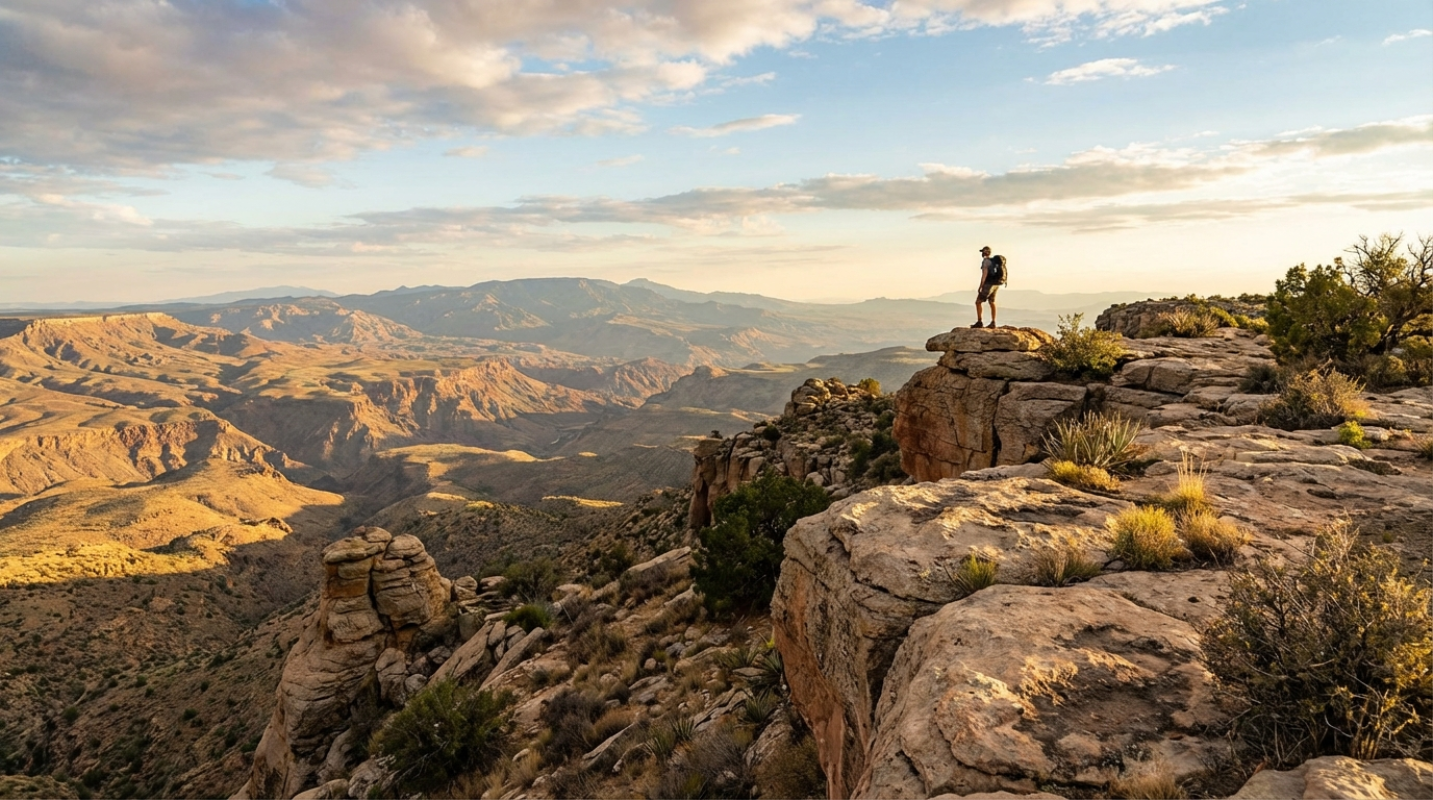
 There’s a unique feeling you get when you stand on a high, flat expanse of land. You aren't straining to reach a jagged, distant peak. Instead, you are standing on a natural balcony, overlooking the curved horizon as if the world has been laid out just for you. This is the lasting allure of the plateau.
We often focus our travel goals on mountains, chasing the vertical thrill of a summit. But plateaus offer something fundamentally different. They are defined by their elevation and their startling flatness, providing accessible high ground that promises unparalleled views without requiring technical mountaineering skills.
A truly scenic plateau isn't just high ground. It’s a place where massive geological forces meet human accessibility, creating panoramas that redefine your sense of scale. From sheer coastal drops to vast, sweeping inland plains, these elevated tablelands offer modern travelers a chance to gain perspective, both literal and existential. This guide highlights the diverse global examples that offer the most dramatic views, while also understanding the logistical and sustainability challenges of accessing them in 2026.
The Geological Marvels
To appreciate the view, you first have to understand the stage. Plateaus are geological heavyweights, formed by immense tectonic uplift, volcanic activity, or relentless erosion. Their formation directly dictates the kind of view you get.
Like, high-altitude inland plateaus, like the vast Tibetan Plateau, result from continental collision, pushing the earth’s crust upward over millions of years. This creates the "Roof of the World," where the views are characterized by extreme elevation, thin air, and seemingly infinite horizons.
Contrast that with a coastal or inland tableland, often formed by massive ancient lava flows, known as traps, or by erosion that strips away softer rock layers, leaving behind a cap of durable rock. The Deccan Traps in India, like, are the remnants of one of the largest volcanic features on Earth. The views here are less about sheer height and more about dramatic, often stepped, terrain carved by rivers.
Geologists view these landforms as historical windows, capturing epochs of intense planetary change. But for the traveler, the stark contrast between the flat top and the sharply defined edge is what makes the view so visceral. It's the sudden, dizzying drop-off that allows you to see for hundreds of miles.
The sheer scale of these landforms is drawing unprecedented numbers of visitors. The Qinghai-Tibet Plateau, like, received an astonishing 64 million visitors in 2024, a volume that is approximately 15 times the region’s resident population¹. This massive influx highlights the dual challenge of modern plateau tourism: managing breathtaking beauty while minimizing the impact of millions of admiring eyes.
Must-Visit Plateaus Travelers
If you’re planning an elevated adventure for the coming year, there are three geographically distinct plateaus that stand out for their dramatic views and current visitor infrastructure.
The Colorado Plateau USA
The Colorado Plateau, spanning the Four Corners region of the American Southwest, is the ultimate example of erosional drama. It hasn't been dramatically folded or faulted; instead, it has been lifted and meticulously carved by wind and water, resulting in the Grand Canyon, Zion, and Mesa Verde.
The views here are defined by depth, not just distance. You look down into the Earth's history. Although the views are guaranteed, accessing certain iconic spots requires checking current operational closures.
Due to the important multi-year, $208 million Transcanyon Waterline rehabilitation project at Grand Canyon National Park, key areas and trails are facing temporary closures. If you planned to hike the popular Plateau Point Trail for the famous mid-canyon view, know that sections of it are expected to remain closed until October 2025². This means the 2026 season requires smart planning, focusing on accessible South Rim overlooks like Mather Point or Desert View, which remain open and breathtaking.
The Deccan Plateau India
The Deccan Plateau in central and southern India offers a different kind of elevated experience: lush, rolling hills and ancient cave systems etched into basalt rock. Although historically less famous internationally than the Himalayas, the Deccan region is seeing major investment in sustainable tourism.
The Indian government, through the Swadesh Darshan 2.0 (SD 2.0) scheme, is channeling significant funds into developing eco-friendly destinations. In the 2024-2025 financial year, roughly $397 million USD (₹3295.76 crore) was sanctioned for sustainable and responsible tourism initiatives across 23 states³. This investment means that destinations like the Saputara hill station are receiving infrastructure upgrades designed specifically for environmental protection and local community benefit. You’ll find modern, well-maintained facilities that prioritize local culture, offering a responsible way to enjoy the subtropical panoramas.
The Gilgit-Baltistan Plateau Pakistan
For the traveler seeking true high-altitude immersion, the plateaus of Gilgit-Baltistan in Northern Pakistan, home to Deosai National Park, are increasingly accessible. Deosai is a high-altitude plain known for its stark beauty, unique biodiversity, and views of the surrounding Himalayan and Karakoram ranges.
Recent infrastructure improvements, particularly the elevation of Skardu Airport, have made this region significantly easier to reach. This improved access contributed to a dramatic 121% increase in international tourists to Baltistan in 2024 compared to the previous year. Although this is fantastic for regional economies, it means that the pristine environment of Deosai, which saw 74,000 visitors in 2024, is now under intense pressure.
The Sustainability Tightrope: Balancing Access and Ecology
The paradox of the plateau is that the more accessible these elevated vistas become, the more fragile they prove to be. The breathtaking views we seek are often found in ecosystems that struggle to cope with the "toeprints" of mass tourism.
The infrastructure required to support millions of visitors, from high-speed rail lines to massive resort developments, can have devastating consequences if not managed completely. Research confirms that road building in mountainous regions, while boosting accessibility, can trigger landslides, cause habitat fragmentation, and disrupt local livelihoods¹⁰.
Consider the Tibetan Plateau again. Although the sheer volume of visitors drives economic growth, the region faces intense pressure. When you have 64 million people visiting a place in one year, the demand for resources and the resulting waste management issues are immense. In Gilgit-Baltistan, like, a 2021 survey found that 60% of visitors to Deosai National Park left non-biodegradable litter, a harsh reminder that the "Leave No Trace" principle isn't just a suggestion; it’s a necessity.
For you, the modern traveler, this means prioritizing sustainability is not optional.
- Stay on the Path - Plateau soils are often thin and fragile. Veering off marked trails causes soil erosion and damages delicate alpine vegetation.
- Eco-Conscious Choices - Look for accommodations that use renewable energy, such as solar or geothermal power, and prioritize water conservation systems. Water scarcity is a important issue in high-altitude environments.
- Invest Locally - Make sure your spending supports the local communities, not just large international corporations. Sustainable tourism should be community-led, preserving cultural heritage alongside natural beauty.
Choosing to travel responsibly ensures that future generations can experience the same sense of awe you feel when standing on that high edge.
Claiming Your Elevated Perspective
The quest for panoramic views is fundamentally a quest for perspective. When you are standing hundreds or thousands of feet above the surrounding terrain, the complexity of daily life shrinks, and the sheer magnitude of the natural world asserts itself.
Plateaus offer this shift more effectively than almost any other natural formation. They combine the drama of elevation with the stability of solid ground. You don't have to conquer the view; you simply stand upon it.
Sources:
1. Borrowing a Mouth to Speak: Overtourism in China’s Imagined Tibet
2. Government sanctions 40 tourism development projects
3. Balancing Development and Sustainability: Lessons from Roadbuilding in Mountainous Asia
The information provided on MyUSAI regarding travel destinations, including but not limited to routes, prices, cultural descriptions, and historical data, is for general informational and educational purposes only.